
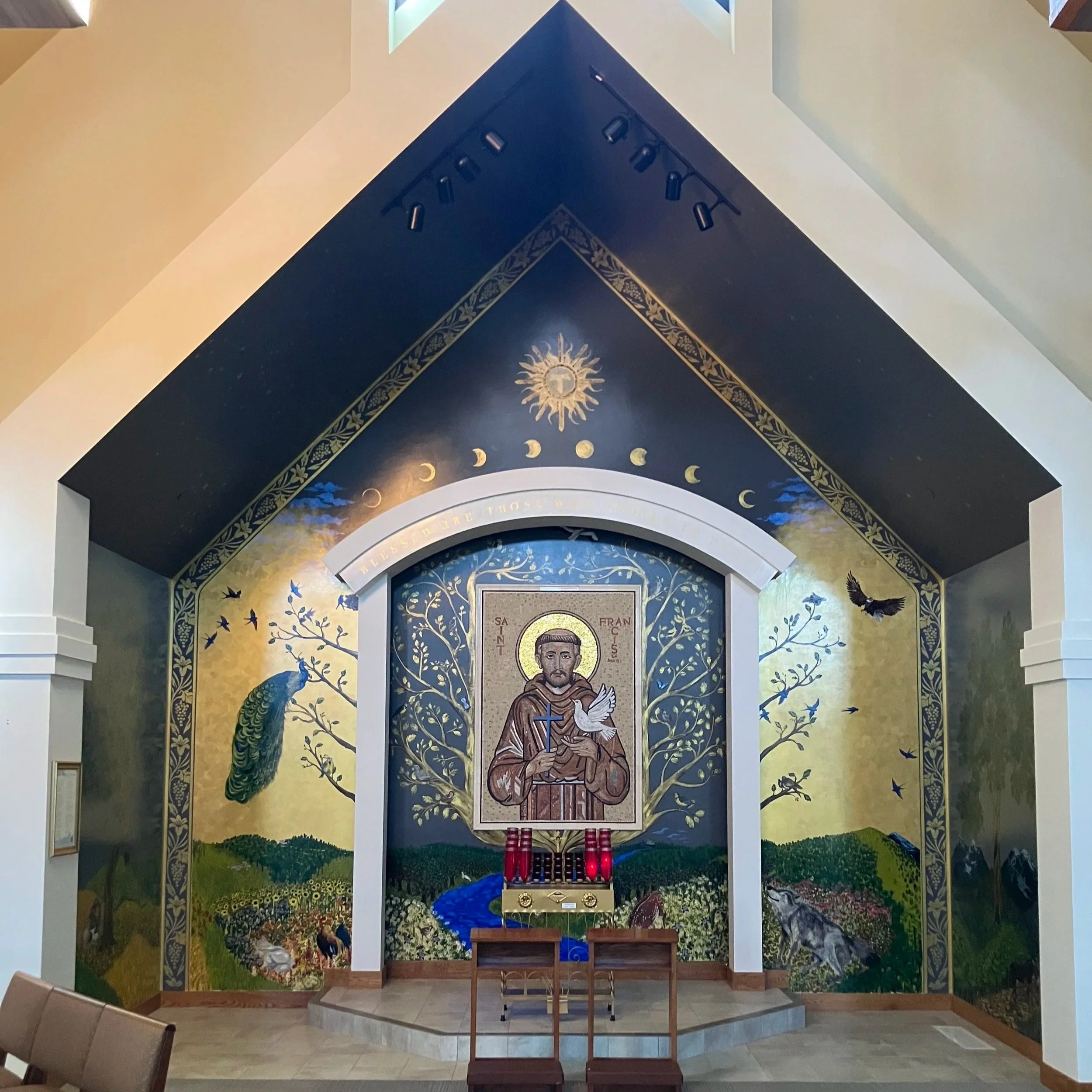
Canticle of the Creatures Mural. Mural by Jane Proulx (Lux Aeterna Studio), Mosaic by Phoenician Arts (Beirut, Lebanon).
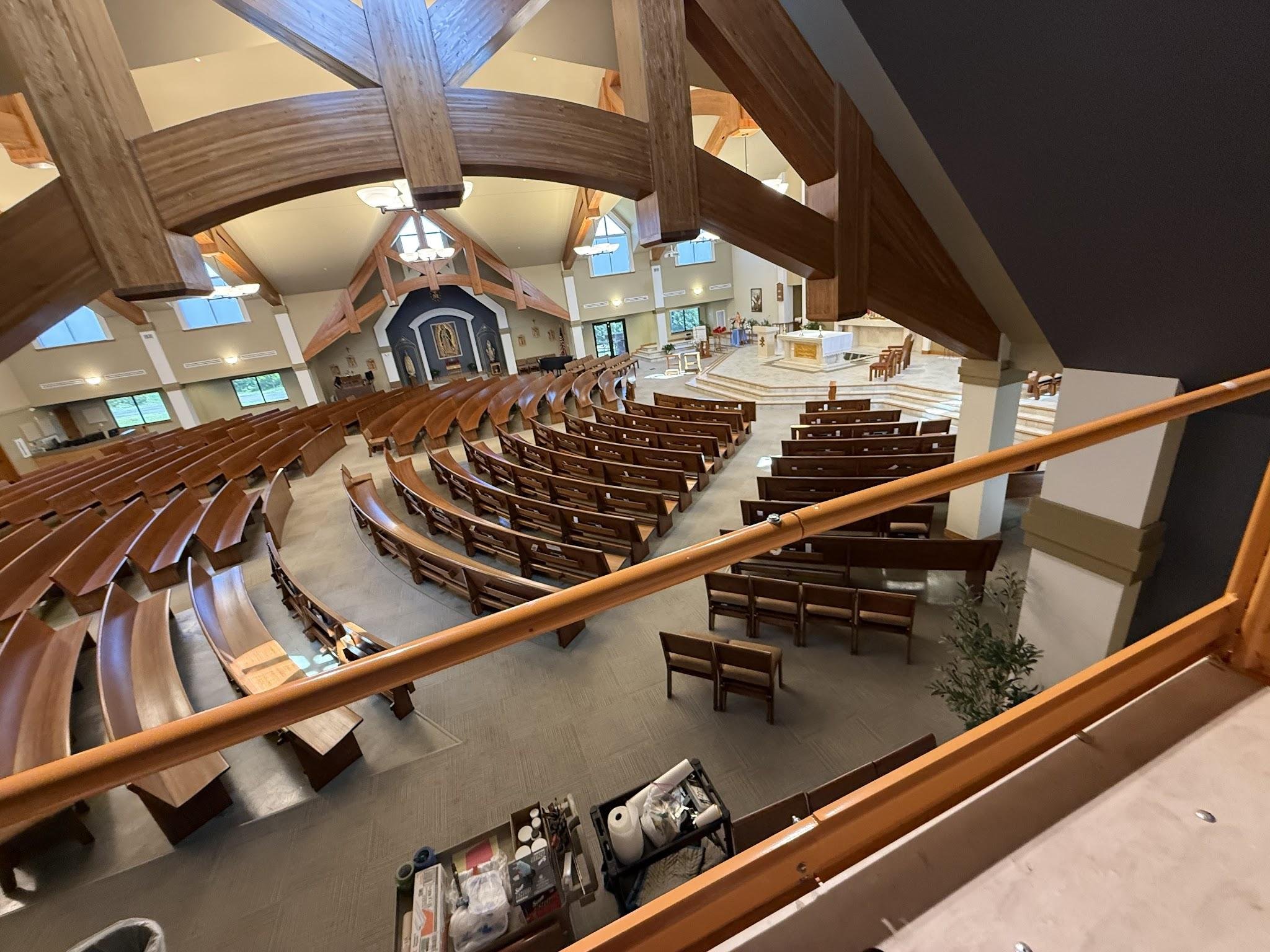
Welcome to the artistic and spiritual story behind the Canticle of the Creatures Mural! Conceived during the Jubilee Year of St. Francis, this breathtaking work of art transforms St. Francis of Assisi’s famed song of praise into a living, visual masterpiece within our sanctuary. Born from prayerful discernment and brought to life through a rich collaboration between parish leadership and artist Jane Proulx, the mural serves as a vibrant ladder—inviting every viewer to look through the beauty of creation to see the goodness of God Himself. Within this document, you will discover the deep intentionality, rich biblical symbolism, and hidden theological details woven into every element of the artwork—from the soaring celestial bodies to the intricate flora and fauna. We invite you to explore the story behind the brushstrokes and join us in letting this mural inspire your own prayers of praise for generations to come.
St. Francis of Assisi wrote his Canticle of the Creatures as a clear poem of praise to the Lord. Every sentence begins with the words “Praise be you, my Lord.” Likewise, this work is meant to be an act of praise. Many hours of prayer were put into the planning of the mural, and many more into its execution. We hope that it will inspire many more prayers of praise, for many generations. We will attempt to describe all of the intentionality behind this effort, but the truth is that the Holy Spirit led this project, and many new connections and meanings have emerged since its completion. In this sense, the mural continues to unfold with prayer, just like His love for us continues to amaze us.
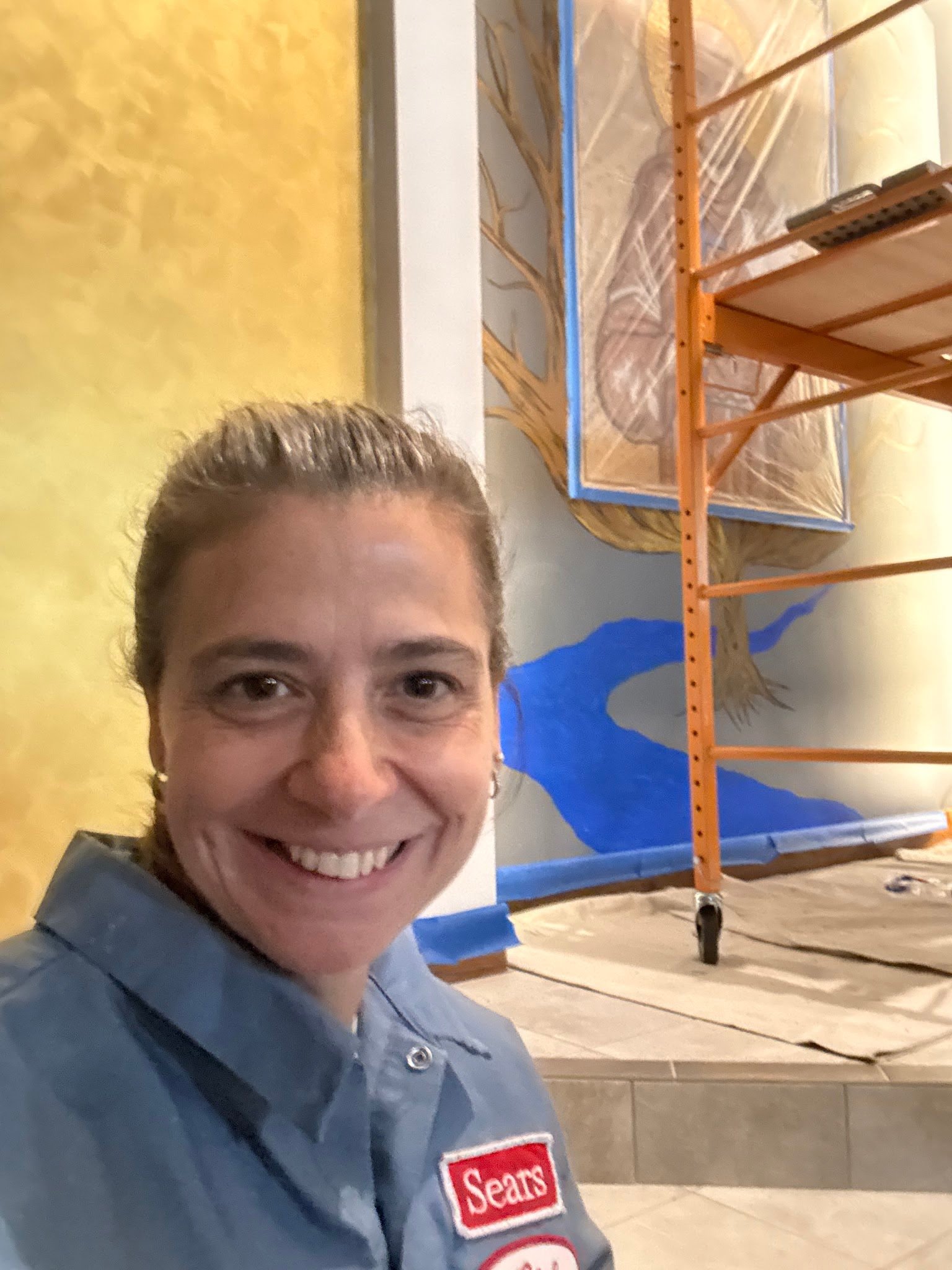
How the Project was Conceived
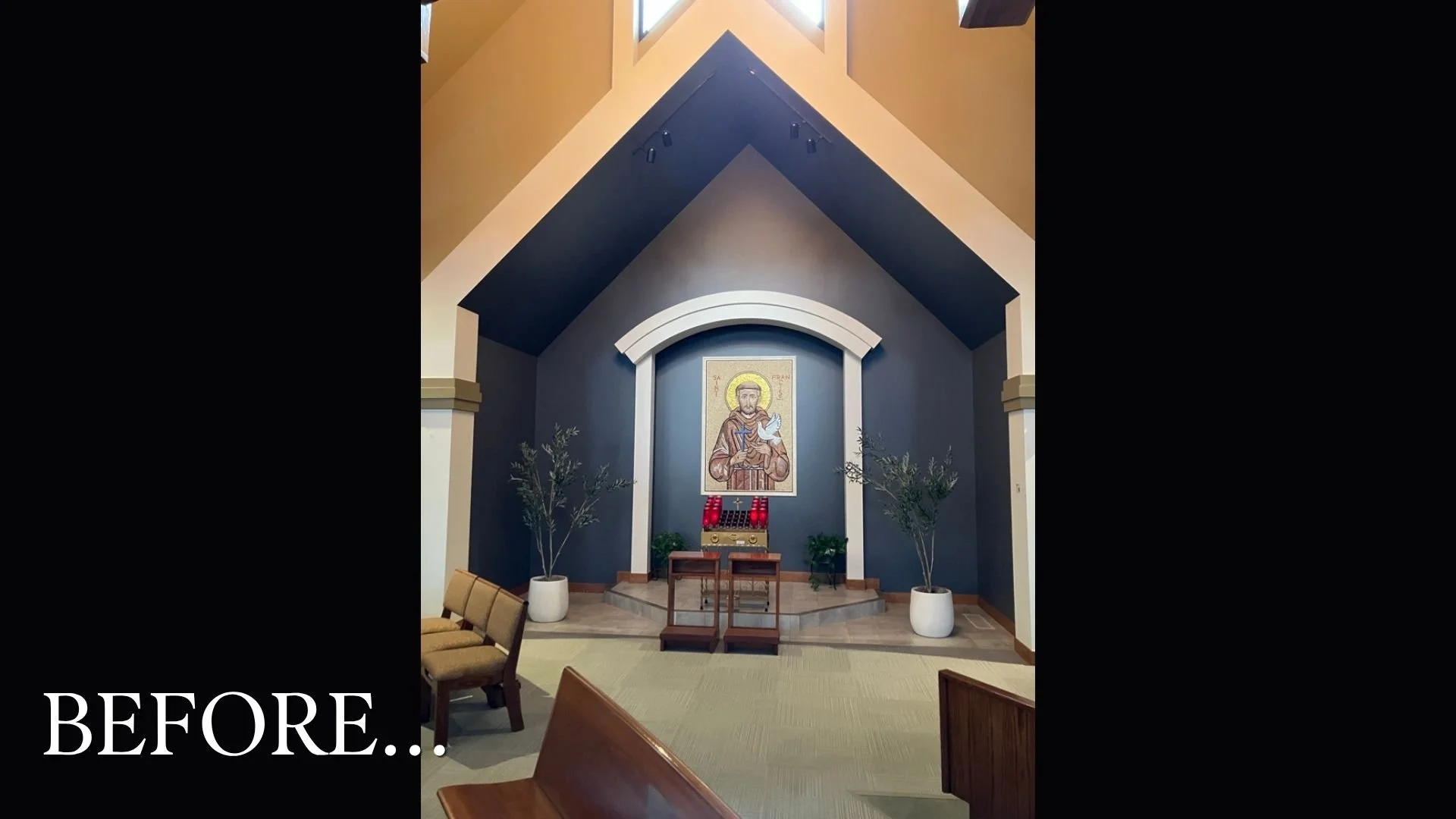
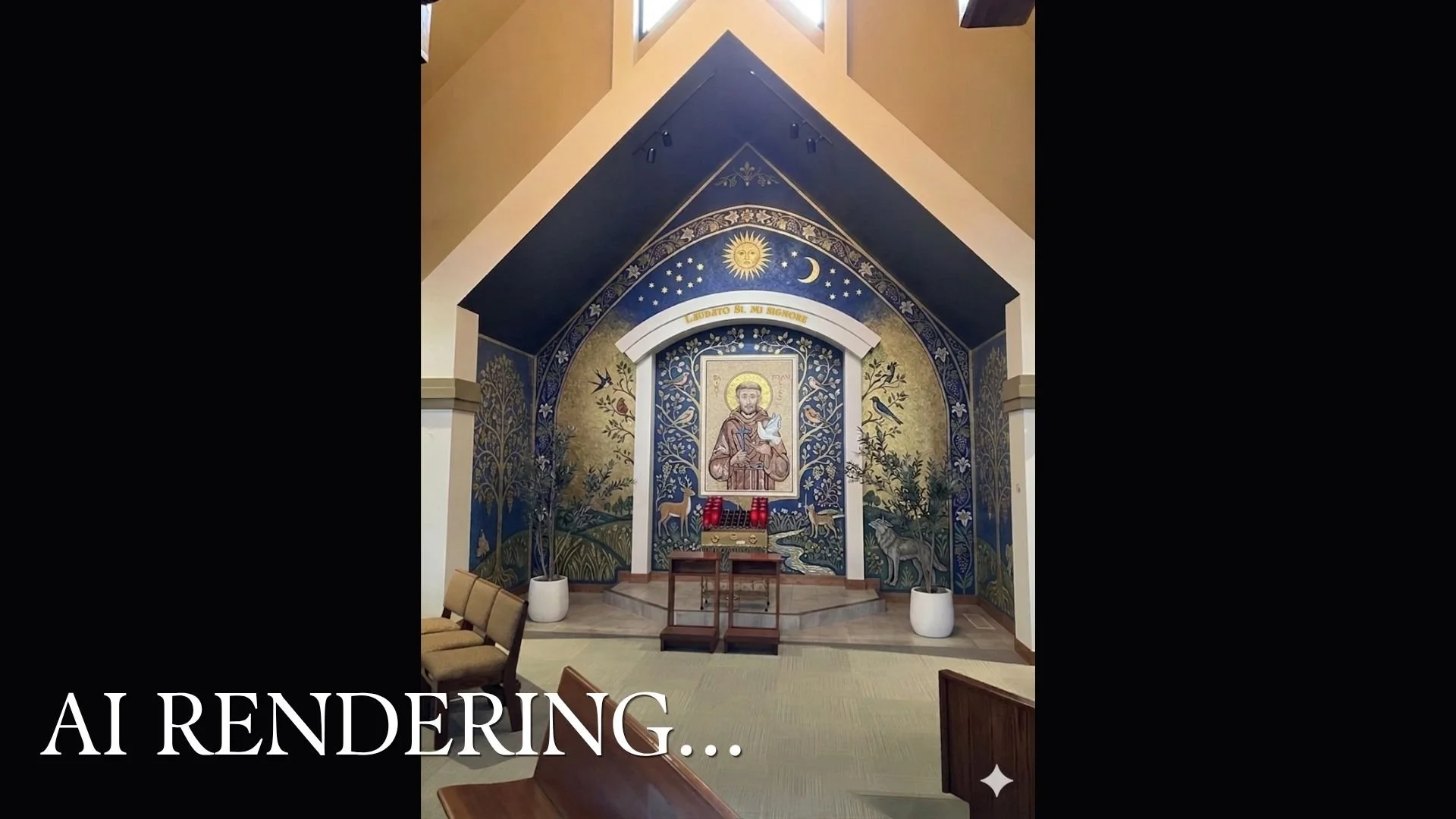
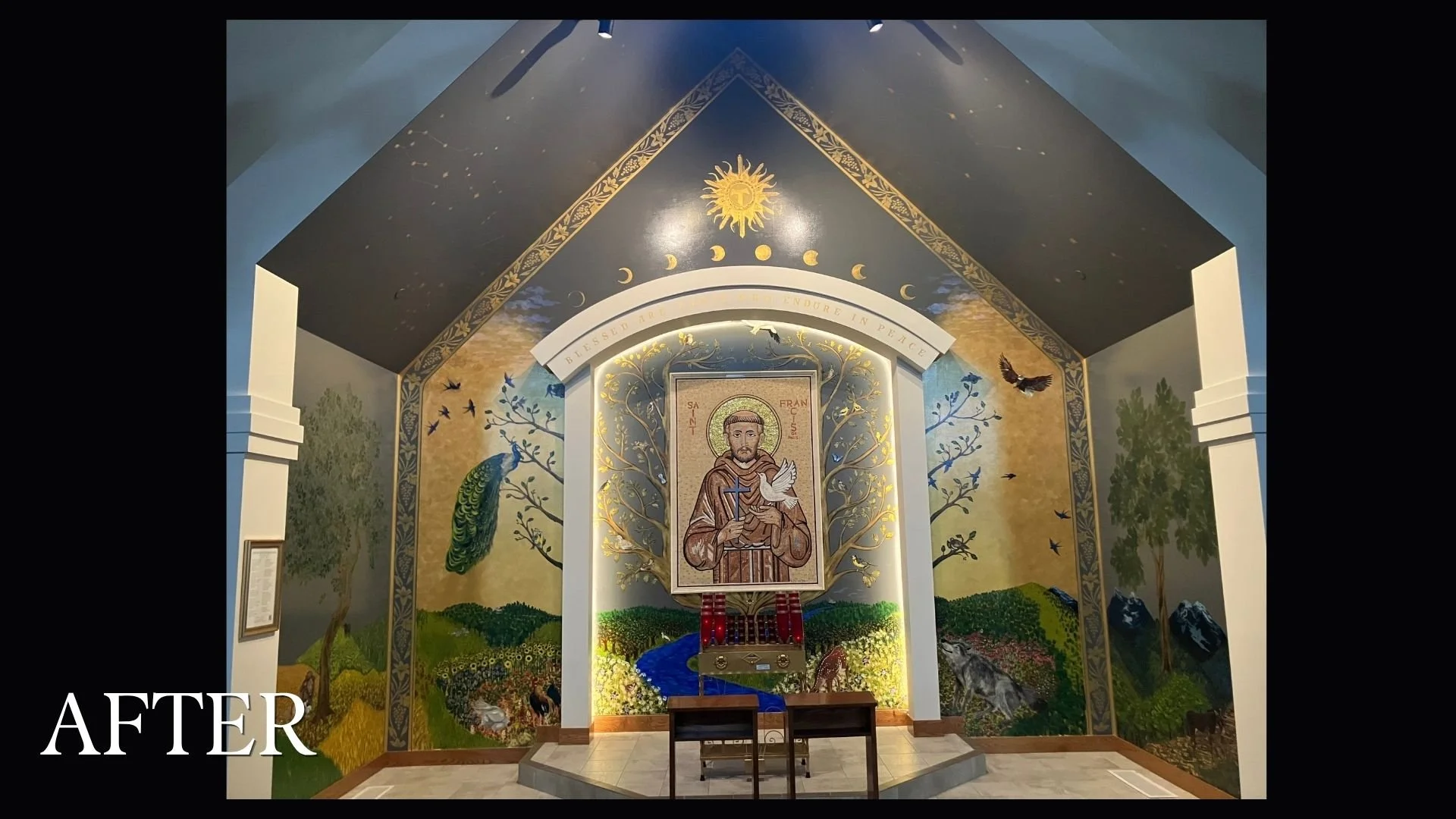
The idea of making a visual representation of the Canticle of the Creatures had been in Fidel’s (Director of Music and Communications) mind for a while, but the Jubilee Year of St. Francis presented a wonderful opportunity and incentive to make this project a reality. Last April, Fidel created a rendering using AI tools (Gemini). After many iterations, he finally arrived at a viable proposal that could be presented to Father Jim and the Leadership Team. The idea was received with enthusiasm, and the search for an artist began. Following months of dedicated work—from initial concept proposals in April to its completion—the mural was joyfully consecrated by our pastor, Father Jim Crisman, on October 9th, 2026.
The Right Partner
Jane Proulx, from Broomfield-based Lux Aeterna Studio, was selected among a group of artists to bring this idea to life. She was an incredible partner to work with, taking the AI renderings and elevating them to a true work of art for the glory of God. She was generous with her time and talent, zealous in her faith, docile in adapting to changes in schedule (we had to pause at some point to wait for Archdiocesan approval) and working with our creative direction, and welcoming to curious parishioners who would approach her to chat or ask questions about her work.
The Poem
Excerpt taken from a plaque in the Convent of San Damiano, Assisi, Italy
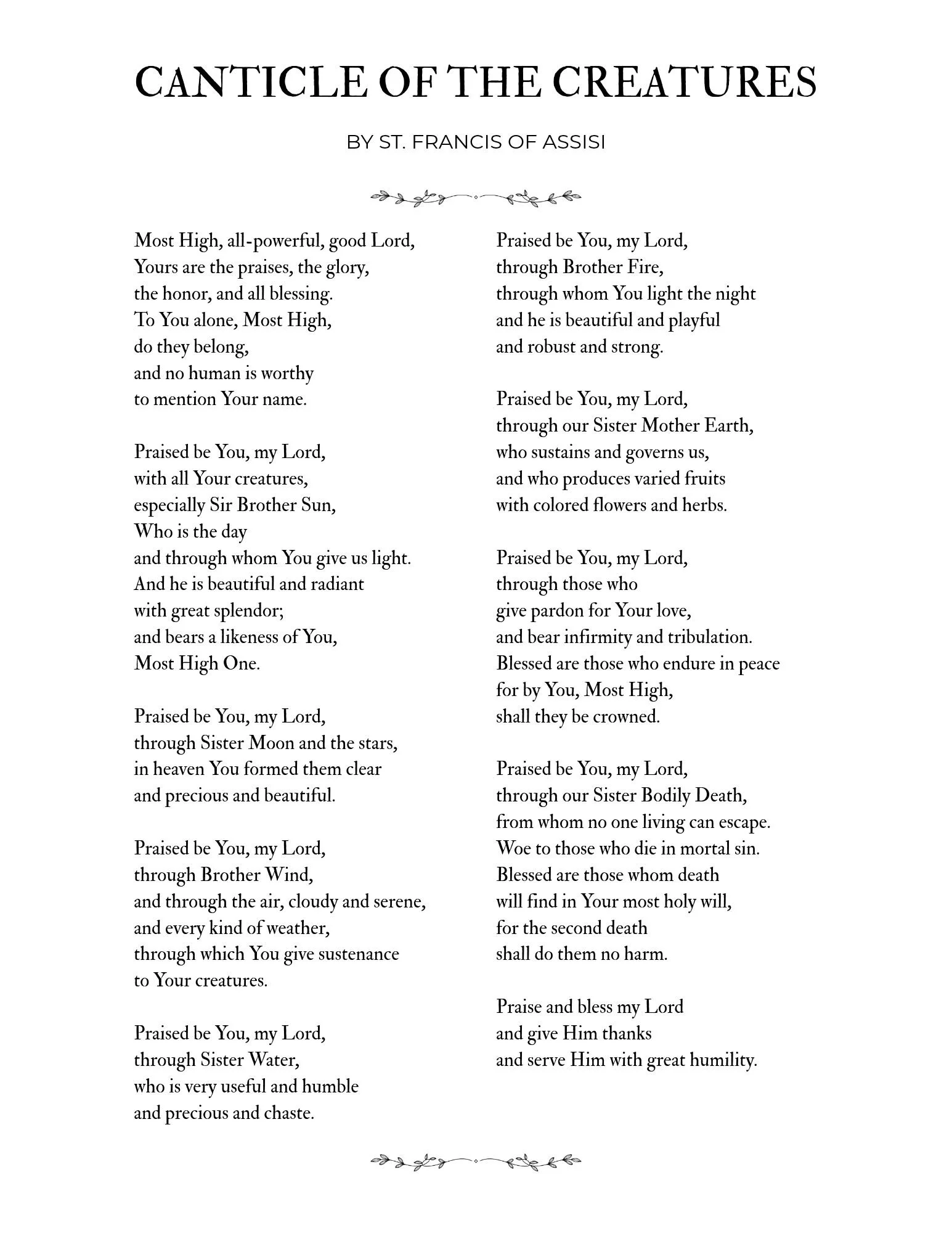
Full text for the Canticle of the Creatures by St. Francis of Assisi
The Canticle of the Creatures, or the Canticle of Brother Sun, is the most famous prayer of Francis. One would immediately think that the Saint had written it in a happy period of his life, when the beauty of the Umbrian countryside filled both his eyes and heart. But it was not like that.
In the winter of 1225, Francis stayed at San Damiano for fifty days or so: he bore the stigmata, was almost blind and could not bear the light of the sun or the fire. The friars built him a little hut in the corner of their house, but the place where he lodged was so infested by rats that jumped up all around him, that he could neither eat nor sleep properly. It was also very cold.
One night Francis prayed to the Lord "Come Lord, help me in my infirmity!"And in his spirit he received the reply "Rejoice, and live serenely as if you were already in my kingdom."
Rising in the morning, he said to his companions "Now I have to rejoice greatly. I want therefore to compose a new praise to the Lord, together with all his creatures, without which, we ungrateful beings, cannot live". And sitting down he began to concentrate and then said "Most High, All powerful Good Lord..." To the text he also added a melody - now lost - which he taught to his companions so that they could go through the world praising God and consoling the hearts of men.”
Preparation Phase - Choosing the Colors
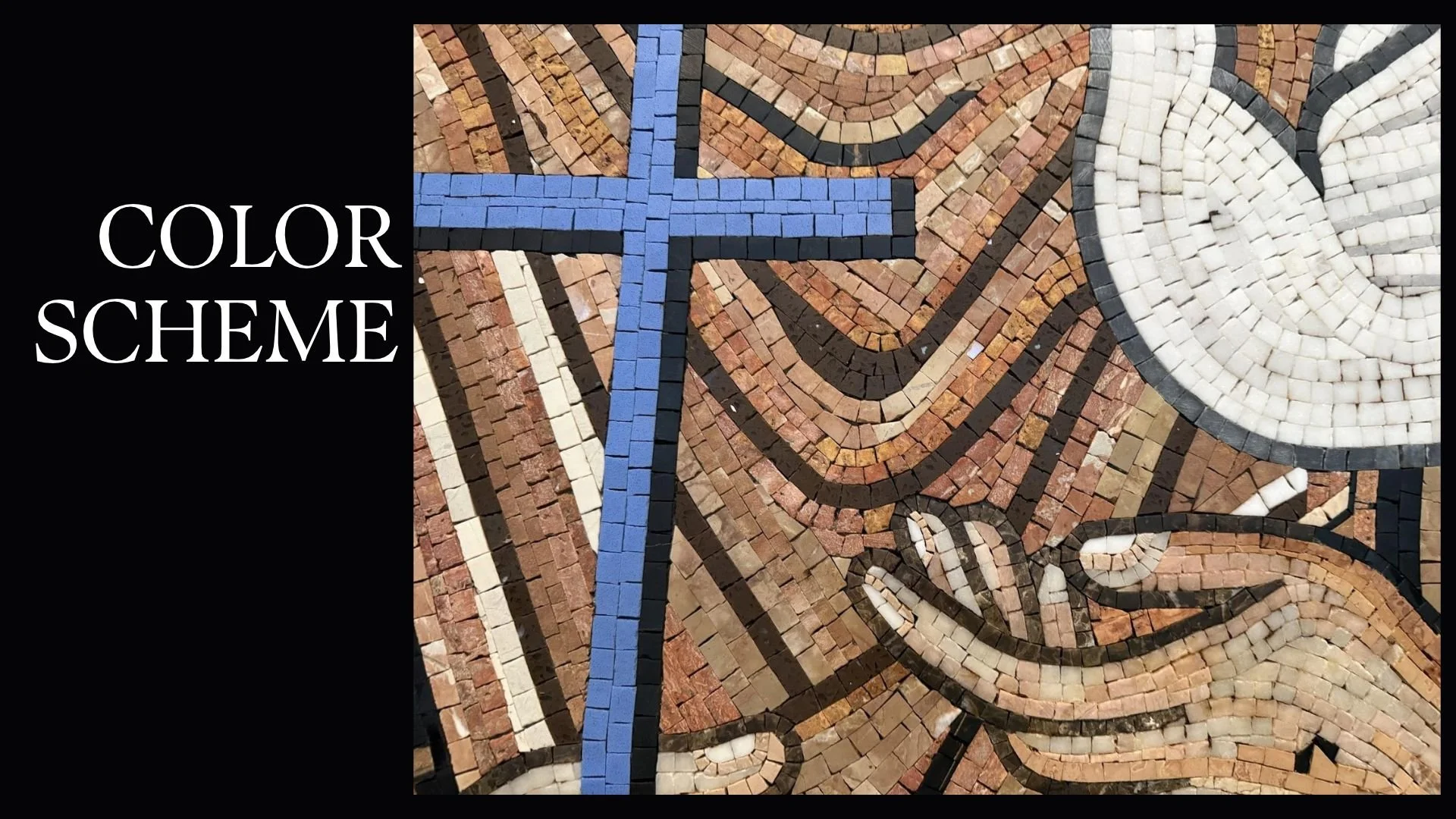
Lots of conversations and planning took place before the first brush stroke. One of Jane’s first areas of focus was on choosing the right color scheme. Since the goal was to highlight and not overshadow the existing mosaic, the initial colors were matched to the individual marble stone pieces making up the mosaic.
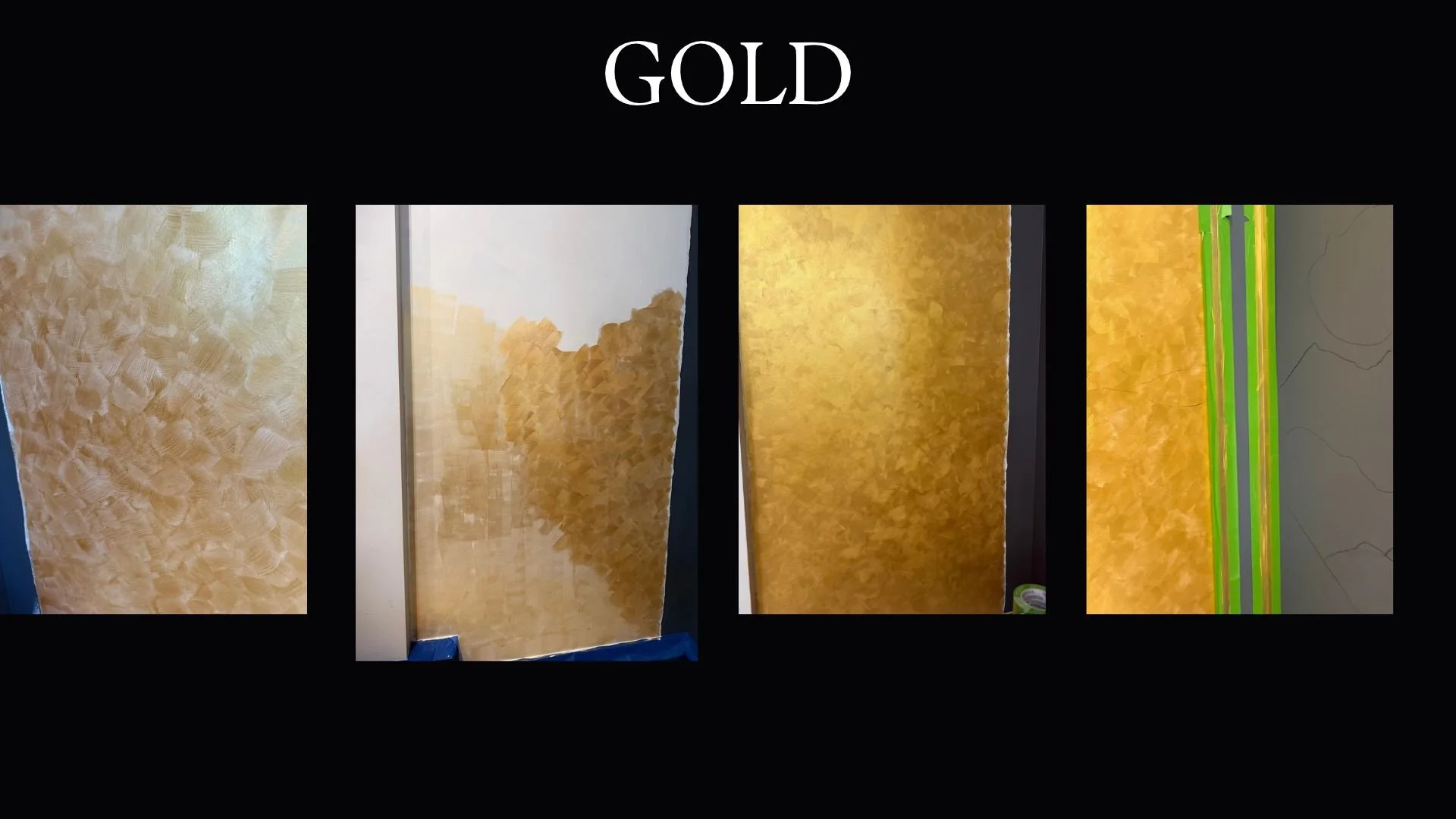
The next big decision was about the gold: the halo of St. Francis is one of the most stunning features of the mosaic, using gold colored glass tesserae (instead of marble tiles). The rendered design included gilded areas, to match the quality of the glass tesserae, and as a visual depiction of God’s graces (represented through the halo) “spilling over” his creation. The idea was clear, but a lot of questions had to be answered first: what type of gold should we use? Gold leaf vs gold metallic paint? What shade of gold, type of paint, texture, application technique, etc? After some tests, we opted for the same metallic gold paint used in the Marian alcove to maintain consistency, and Jane used a special brush technique to create a hammered metal effect for the base coat.
Visual Tour
Brother Sun (and Brother Fire)
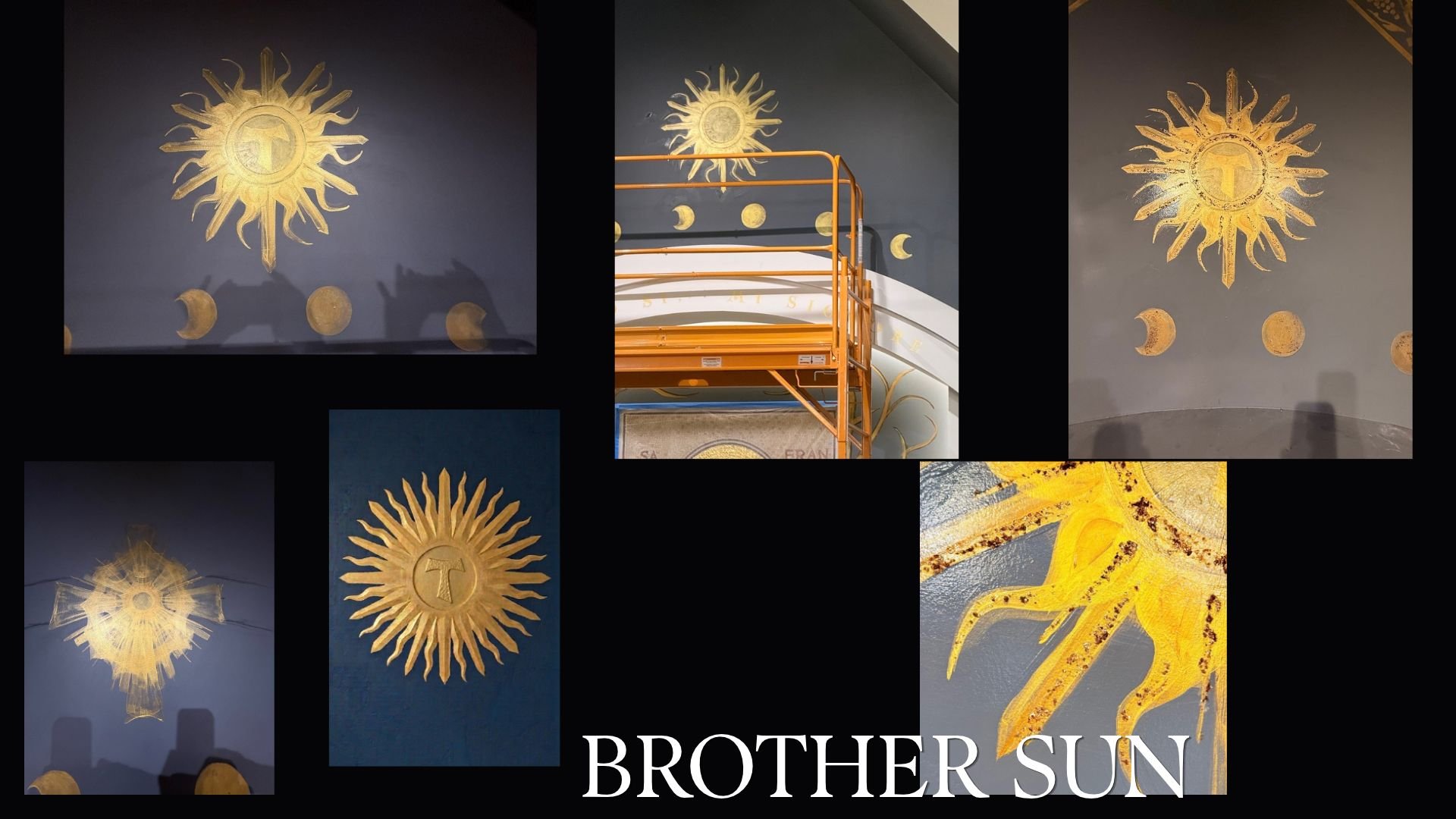
Bottom left: initial sketches for the sun.
The sun has particular prominence in St. Francis’ canticle: “especially Sir Brother Sun”. Likewise, the mural places the sun in a priviledged location, high, above everything else, towering over all the other elements. The location of the sun was also chosen to stand directly across from the Marian emblem in the Marian alcove on the opposite side of the church, thus portraying the relationship of our Blessed Mother to Jesus, reflecting his light to the world.
The sun went through many drafts before settled with this design. If you look closely, you should be reminded of a monstrance. This is inteded to parallel St. Francis’s words regarding the sun, “and [it] bears a likeness of You, Most High One”. A Tao cross is sketched in the center of the sun. Early Christians viewed this symbol (described in Ezekiel 9:4) as a prefigurement of the cross, and St. Francis of Assisi revived it in the 13th century, even using it as his personal signature. The Tau symbol is now commonly associated with Franciscan orders. The blazing flames evoke Francis’ ode, later in the poem, to Brother Fire as “beautiful and playful and robust and strong.”
Calculating the right heigth for the sun, to match the Marian emblem on the opposite wall.
Mica, a natural silicate mineral that reflects light to create a shimmering effect, was added to the flames and the center circumference to give the sun extra texture and flare.
Sister Moon and Stars
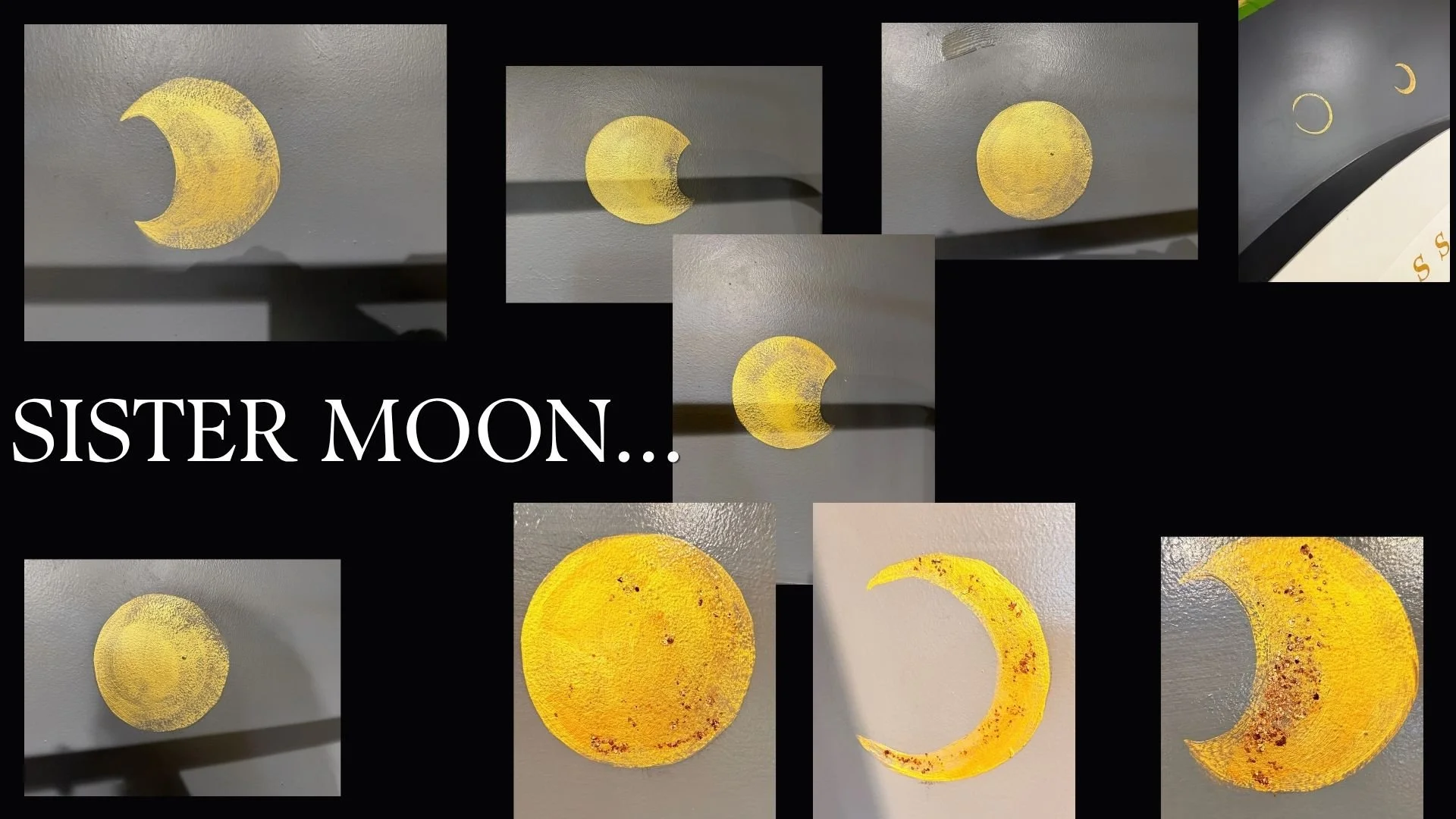
The moon has been displayed with all its phases, to show the fullness of our experience of God’s creation. Fr. Jim Crisman - our pastor, requested for there to be constellations visible all over the world, so as to represent the global reach of St. Francis’ ministry. To accomplish this, we painted constellations visible in Assisi, Italy roughly in a 12-hour window (6pm-6am) on the night St. Francis’ died (Night of October 3d-Morning of October 4th, 1226). These include: Leo, the Unicorn, Orion, Gemini, Triangulum, Pegasus, part of Pisces, Cepheus, Ursa Minor, and Cignus. Special thanks to parishioner and astronomer George Iwaszek for his help with this portion of the project.
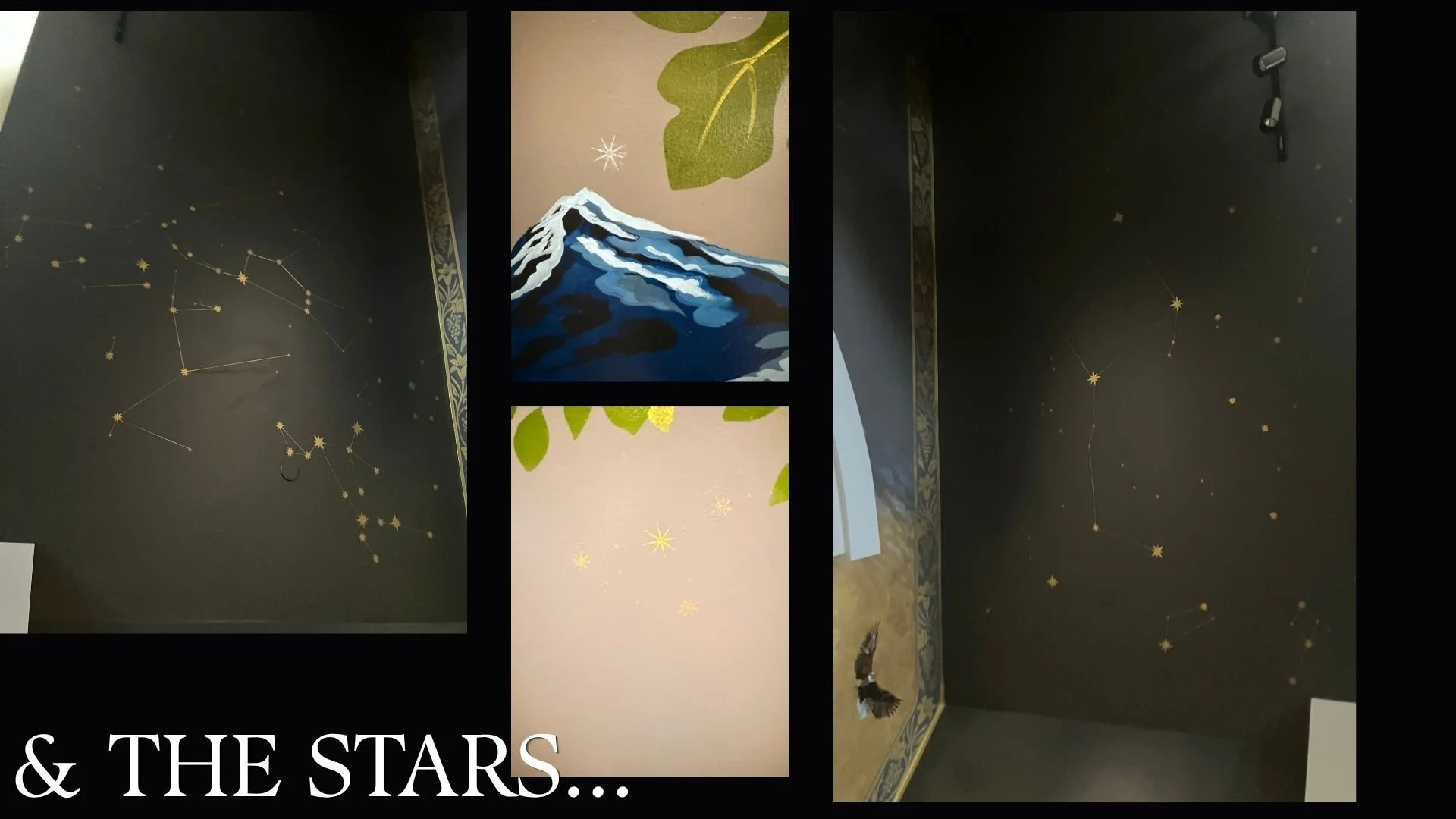
Brother Wind and Sister Water
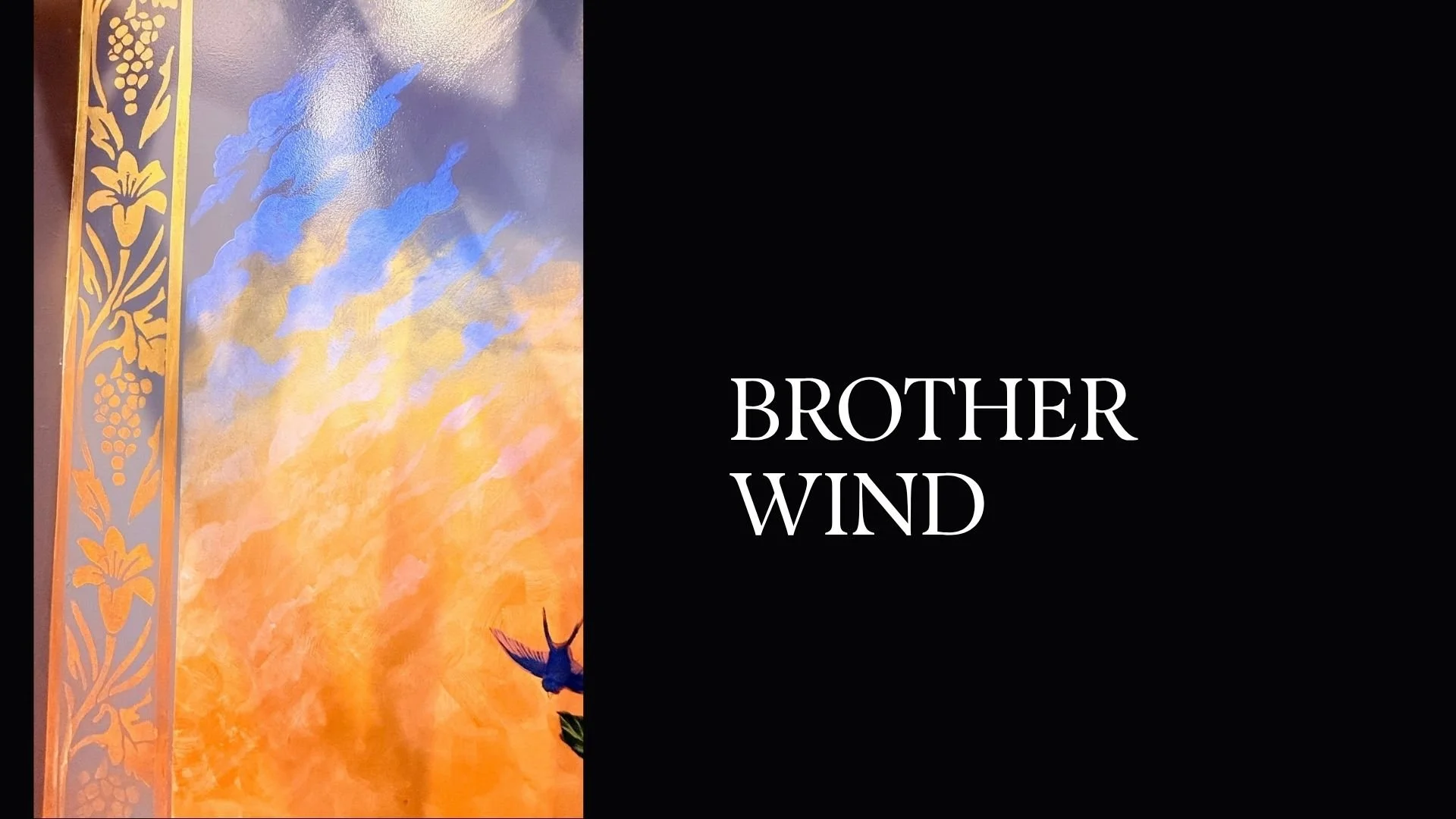
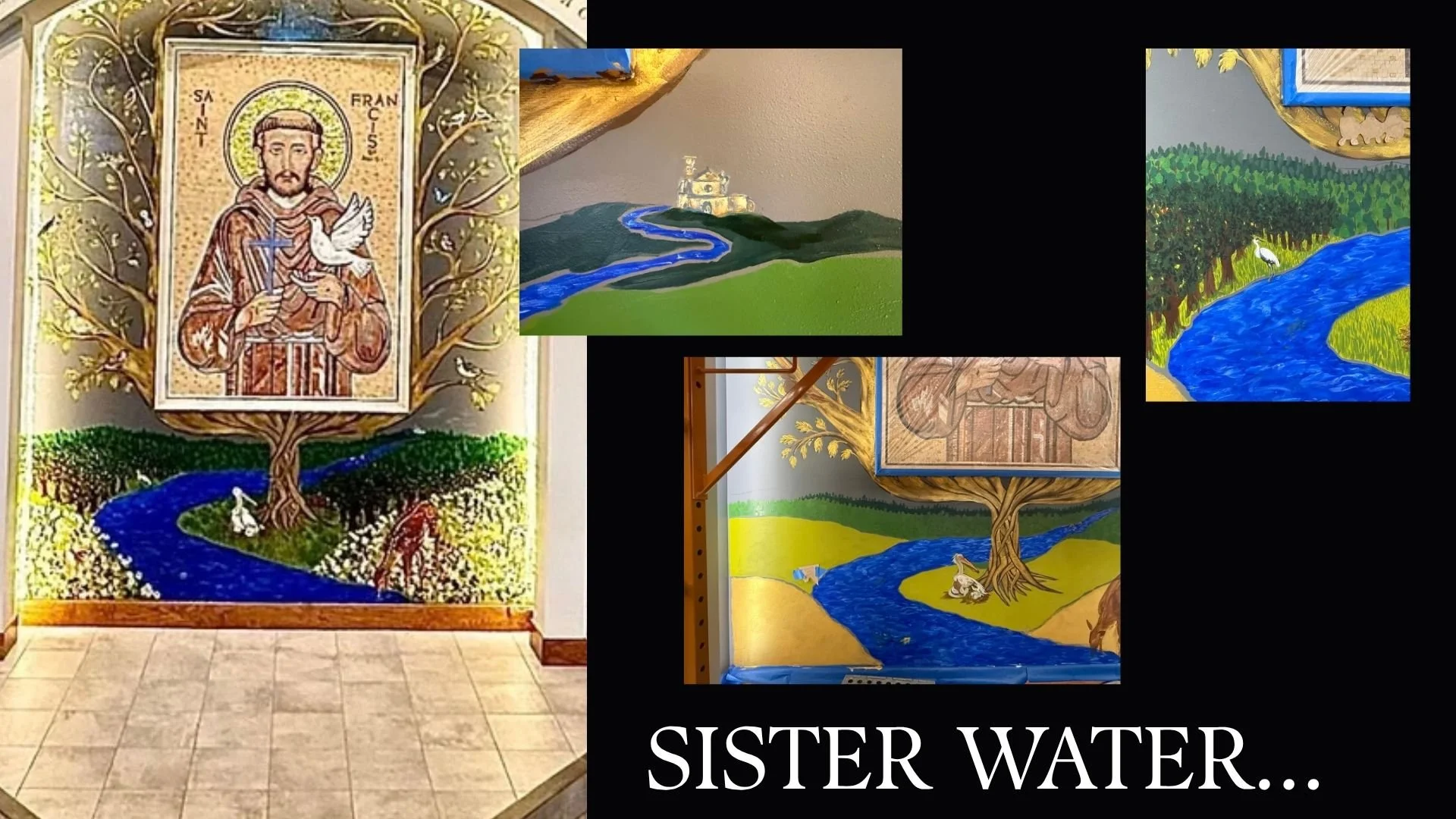
One question was how to transition the gold, where the trees, flowers, and animals are, into the celestial blue area, meant to hold the sun, moon, and stars. Brother wind helped us with this transition. Jane painted patterns of moving clouds (thus “brother wind) to create this transition. For these she used interference paint, a special acrylic that contains mica-coated pigments that reflect light in different ways, slightly changing in tone with the angle of view.
The river flowing down from the church is both a depiction of Sister Water, and a representation of the vision described by the prophet Ezequiel (Ez 47:1-12): “Then he brought me back to the entrance of the temple; there, water was flowing from below the threshold of the temple toward the east (for the temple faced east); and the water was flowing down from below the south end of the threshold of the temple, south of the altar…Going on eastward with a cord in his hand, the man measured one thousand cubits, and then led me through the water; and it was ankle-deep. Again he measured one thousand, and led me through the water; and it was knee-deep. Again he measured one thousand, and led me through the water; and it was up to the waist. Again he measured one thousand, and it was a river that I could not cross, for the water had risen; it was deep enough to swim in, a river that could not be crossed. He said to me, “Mortal, have you seen this?” Then he led me back along the bank of the river. As I came back, I saw on the bank of the river a great many trees on the one side and on the other. He said to me, “This water flows toward the eastern region and goes down into the Arabah; and when it enters the sea, the sea of stagnant waters, the water will become fresh. Wherever the river goes, every living creature that swarms will live, and there will be very many fish, once these waters reach there. It will become fresh; and everything will live where the river goes….On the banks, on both sides of the river, there will grow all kinds of trees for food. Their leaves will not wither nor their fruit fail, but they will bear fresh fruit every month, because the water for them flows from the sanctuary. Their fruit will be for food, and their leaves for healing.”
We get to hear an excerpt of this vision every year at the Easter Vigil. While newly blessed holy water is being sprinkled around the church, the choir sings: “I saw water flowing from the right side of the temple, alleluia!” The church painted in the mural to represent the temple mentioned in the antiphon, is meant to resemble the upper church of the Basilica of St. Francis, in Assisi.
Sister, Mother Earth
All the flora and fauna was carefully selected by Jane and the St. Francis team to have Christian symbolism. Here is the full list:
FAUNA
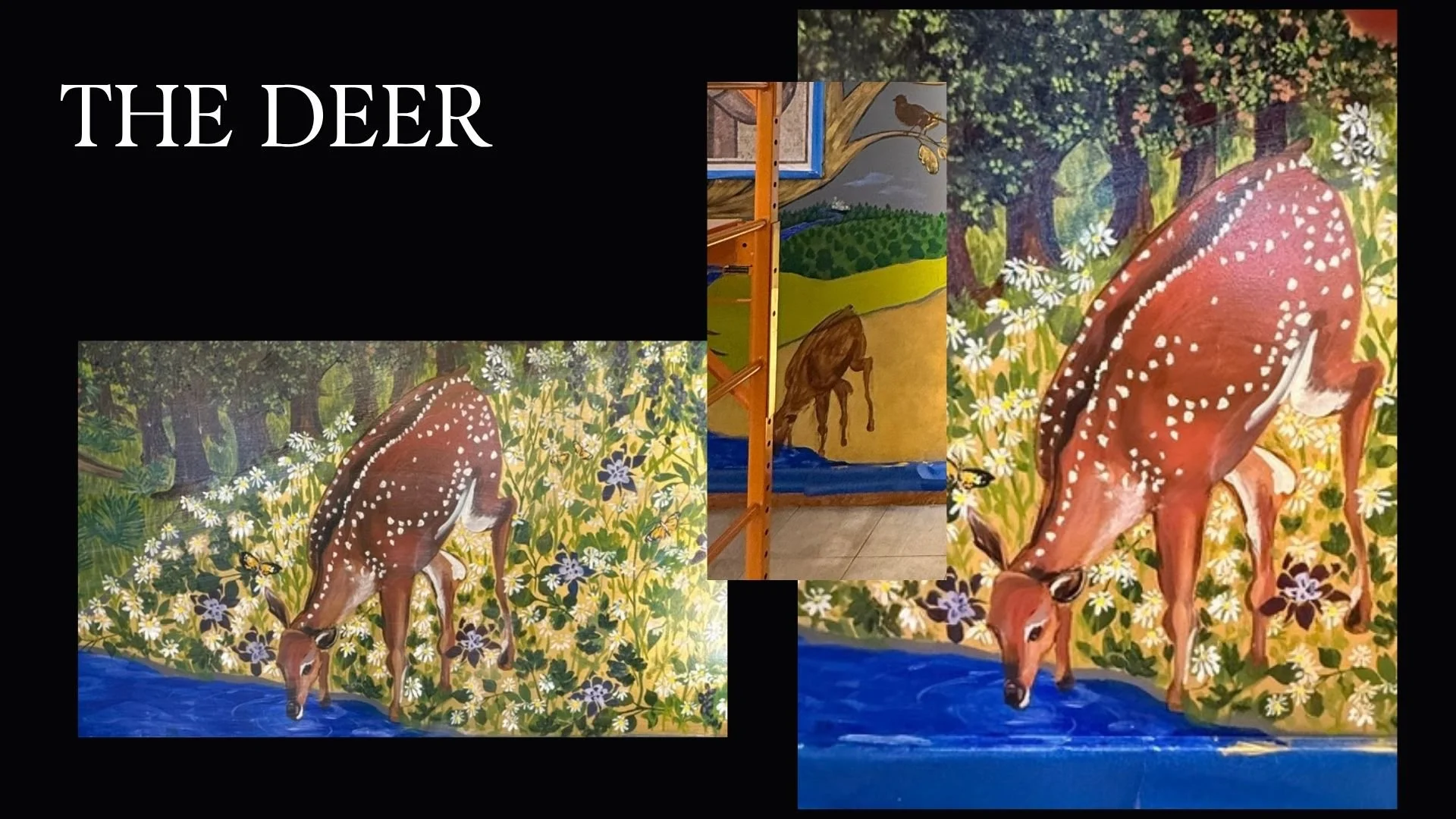
The deer: From Psalm 42: “As the deer longs for running streams, so my soul longs for you My Lord.” This was one of St. Francis’ favorite psalms. Because of this psalm, the deer became associated with the soul’s desire for purification through Baptism and the Holy Eucharist in Christian Art. The prophet Habakkuk also uses the image of the female deer (“hind”) to represent the Christian path: “God, the Lord, is my strength; he makes my feet like hinds’ feet, he makes me tread upon my high places.” (Habakkuk 3:19)
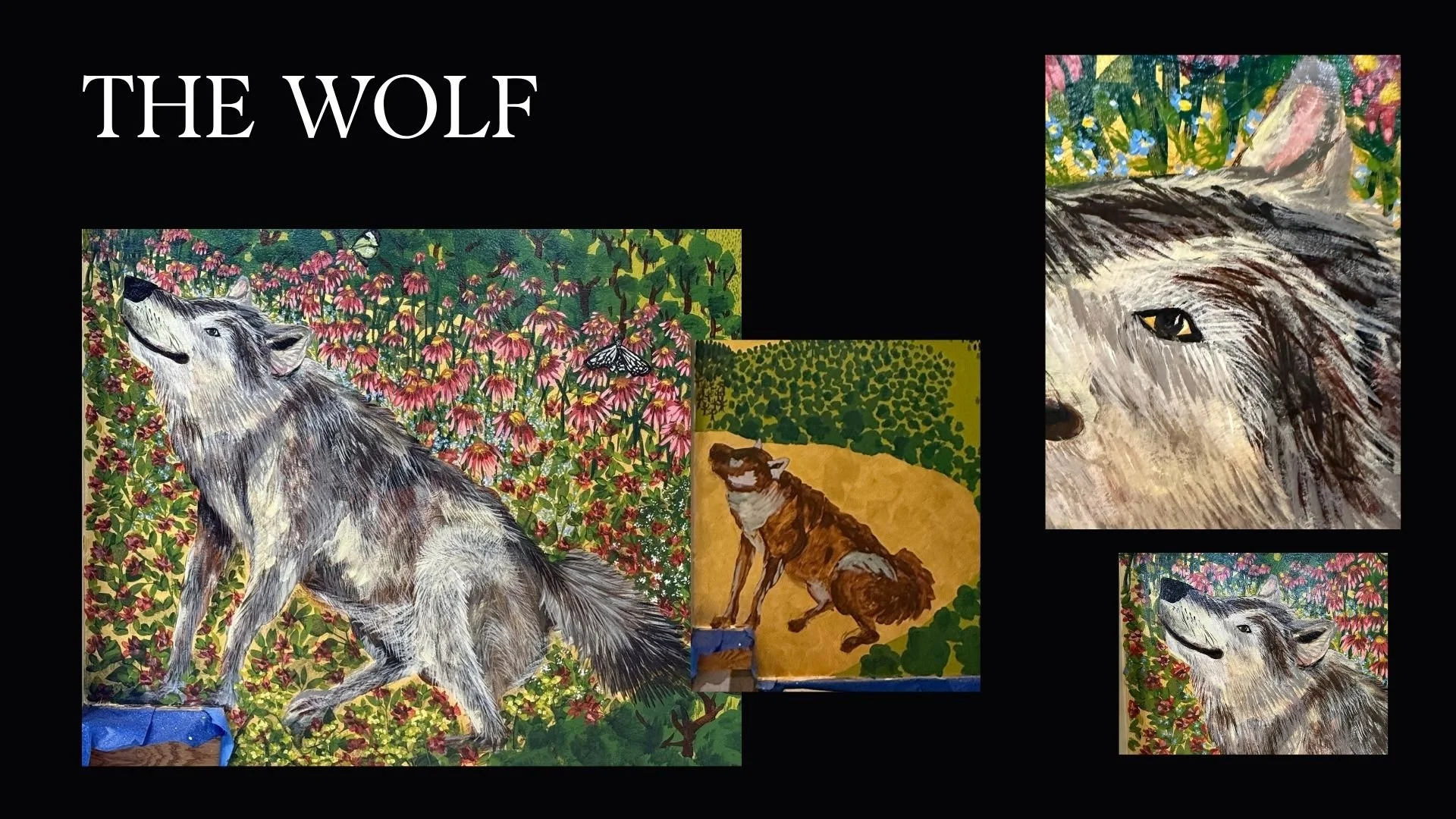
The wolf: The “Fioretti” or “Little Flowers of St. Francis was a famous 14th century collection of stories about St. Francis of Assisi. On Chapter 21, it features a story about St. Francis taming a wolf in the Italian city of Gubbio., negotiating a pact of peace between the hungry animal and the terrified townspeople: “Whereupon St. Francis advanced towards him [the wolf], and making over him the sign of the most holy Cross, called him unto him and spake to him after this manner: ‘Come hither, friar wolf. I command thee in Christ's name that thou do no harm to me nor to any other…I desire, friar wolf, to make peace between thee and them…I promise thee that, so long as thou shalt live, I will cause thy food to be given thee continually by the men of this city, so that thou shalt no more suffer hunger’…And the wolf went with him obediently, like a gentle lamb.” This last phrase is making a reference to a vision from Isaiah “The wolf shall dwell with the lamb, and the leopard shall lie down with the kid, and the calf and the lion and the fatling together, and a little child shall lead them.” (Is 11:6)
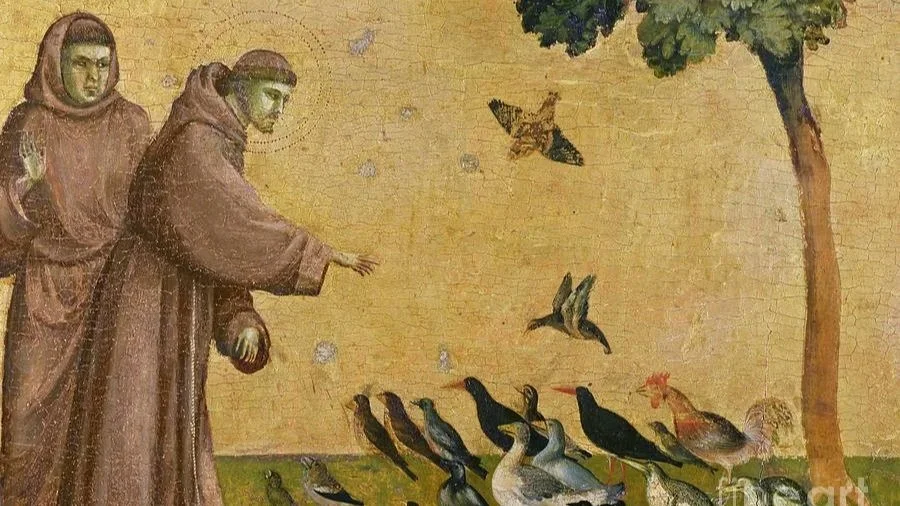
“Sermon to the Birds” by Giotto Di Bernardone, 1297-1299 (Located in the upper church of the Basilica of St. Francis of Assisi, in Assisi, Italy)
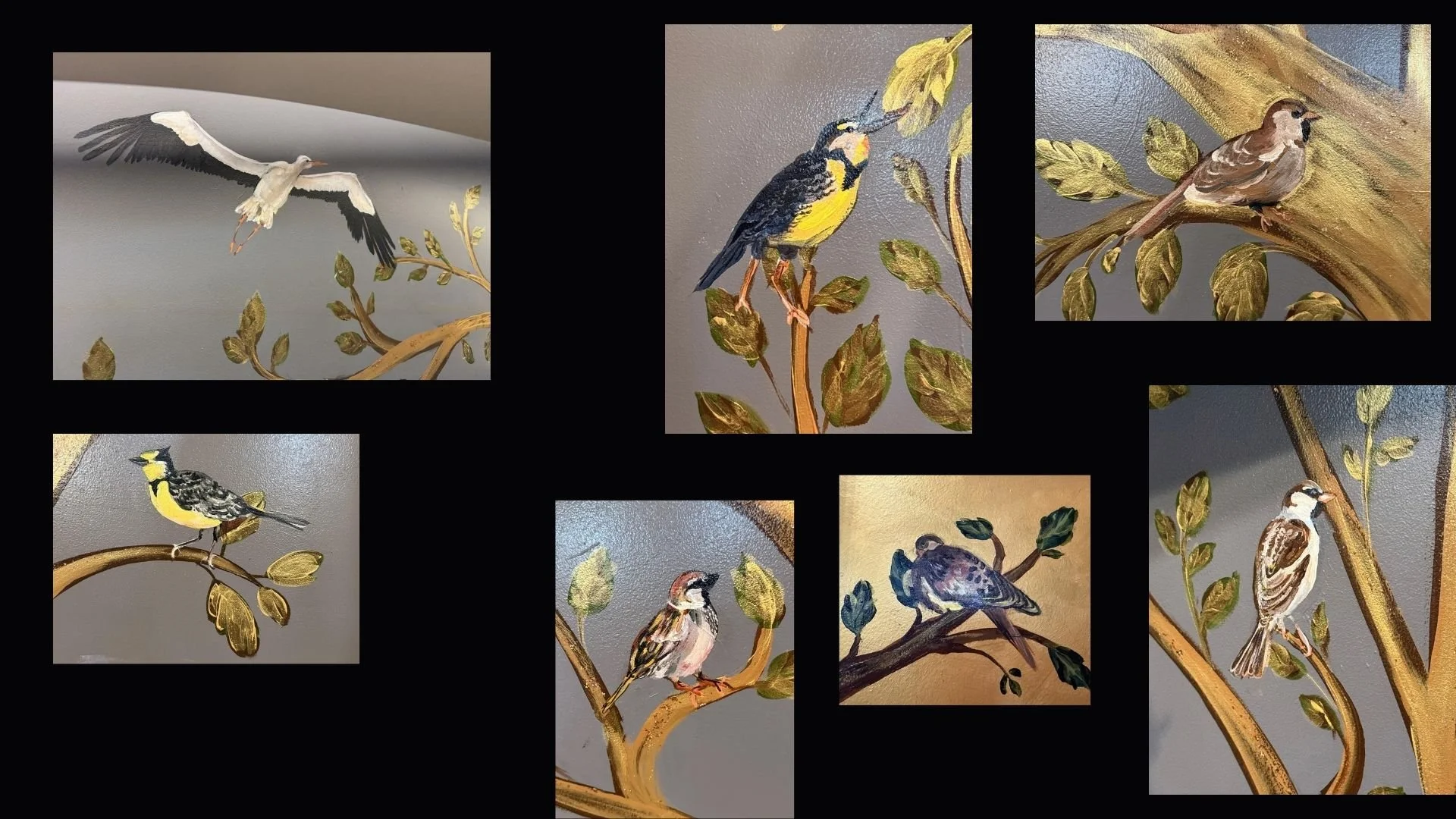
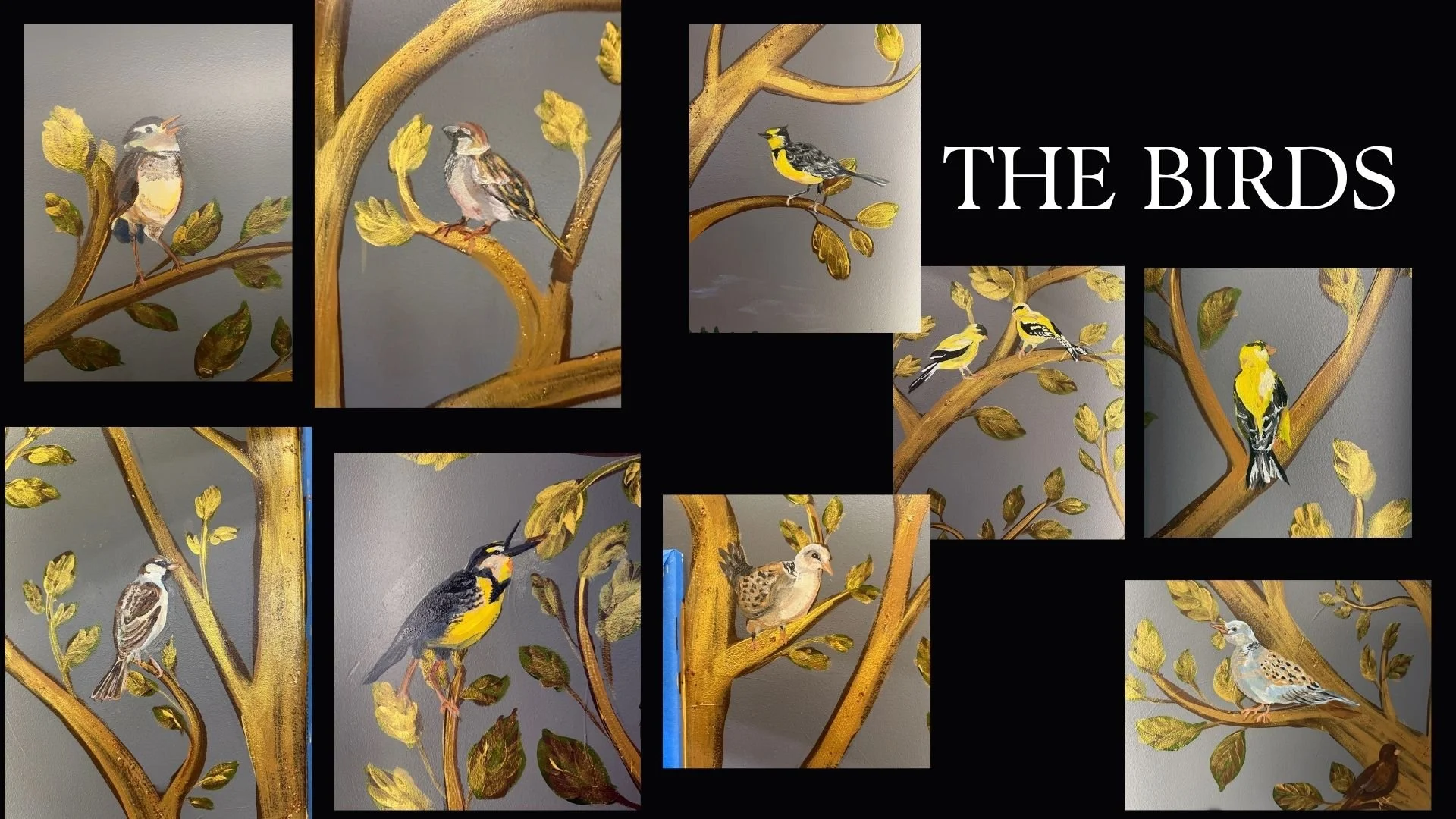
The birds: Most of us have seen garden statues of St. Francis with a bird on his shulder, or paintings of him preaching to the birds. A popular story about St. Francis tells how of his preaching to a large flock of gathered birds in the Spoleto Valley, using the moment to remind all creation to praise God. According to St. Bonaventure, however, this was an act of obedience. Francis had requested to live as a hermit. When a brother communicated the order’s decision for him not to retreat, but rather to continue preaching, he decided to preach. Since he didn’t have an audience to preach, then he preached to the birds.
The stork: Storks are migratory birds that return in the spring, so early Christians viewed them as heralds of a new season. It became a symbol of the annunciation.
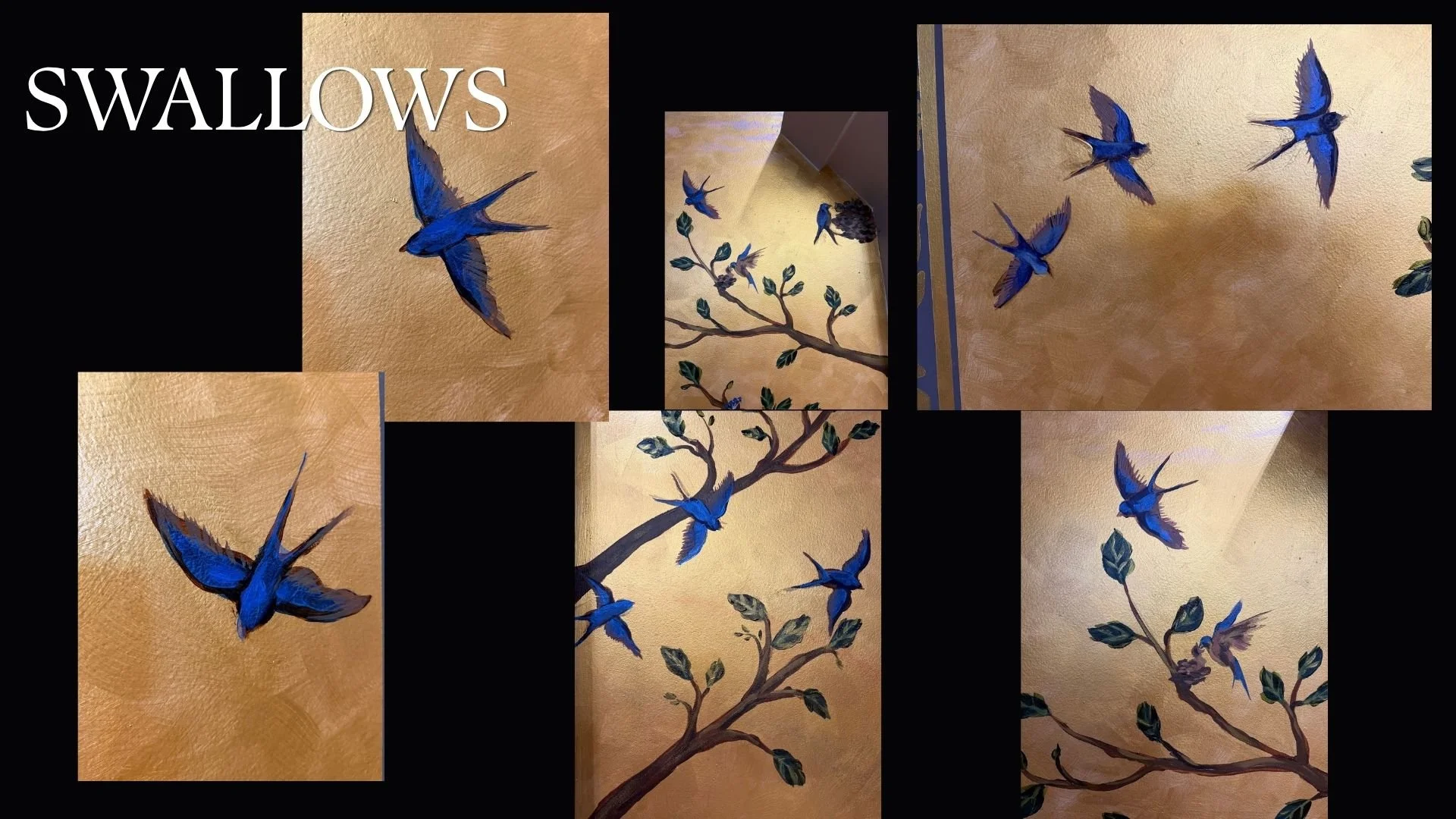
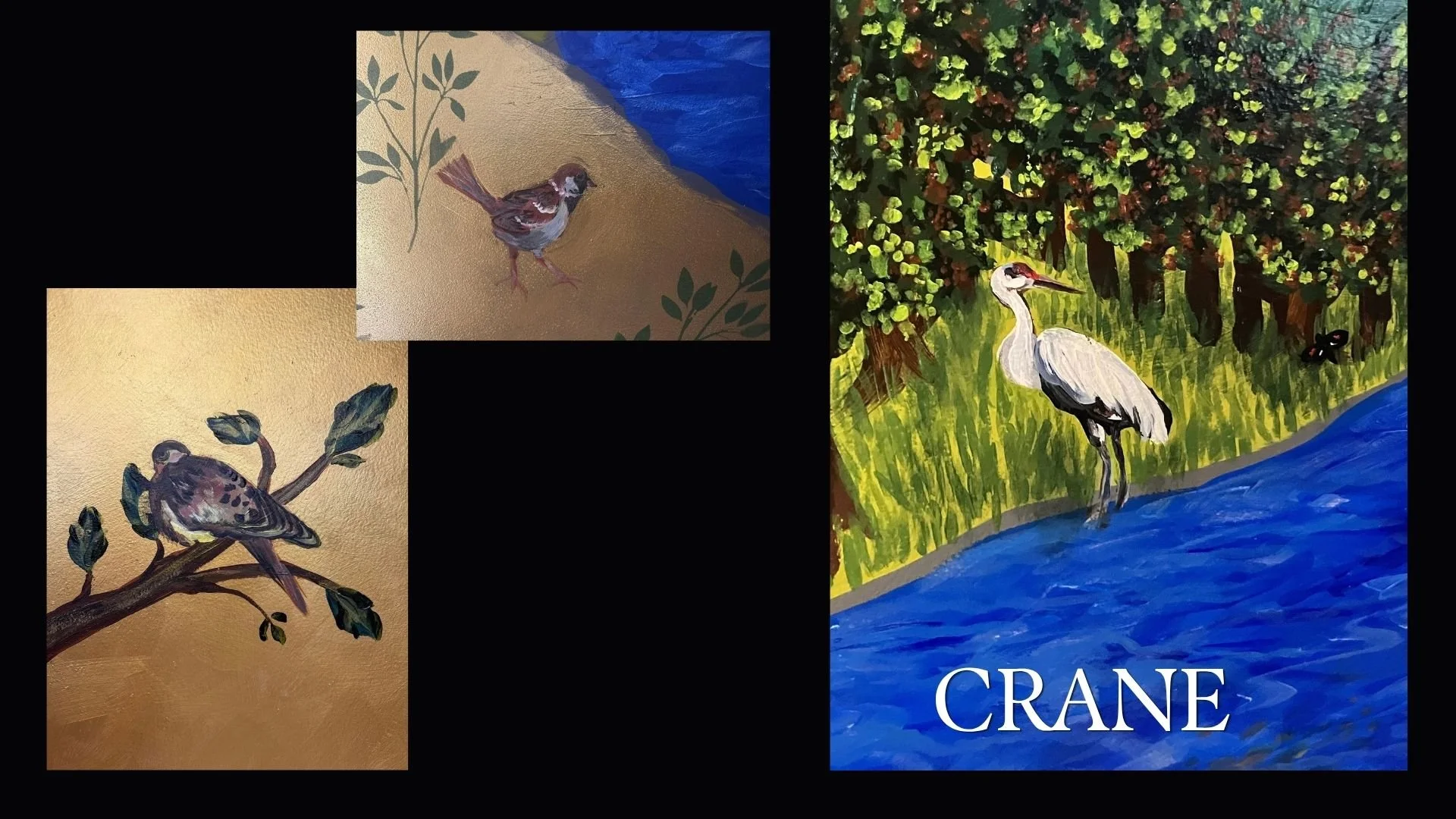
The sparrow and the swallows: Ps 84:3 “Even the sparrow finds a home, and the swallow a nest for herself, where she may lay her young, at thy altars, O Lord of hosts, my King and my God.”
The mourning dove: a specific type of turtledove. This was the sacrifice that the Holy Family offered at the temple during the presentation of Jesus. (Luke 2:22-24). The dove is of course mentioned many more times in the Bible, from Genesis, with the dove carrying the olive branch back to Noah (Gen 8:11) to it representing the Holy Spirit at the Baptism of Jesus (Matthew :16).
The goldfinch: Represents Christ’s passion. A medieval legend says that a goldfinch tried to pull a thorn from the crown of thorns of Jesus on his way to Calvary. As he attempted to do this, a drop of Christ’s blood splashed onto it, permanently staining red the feathers of its head.
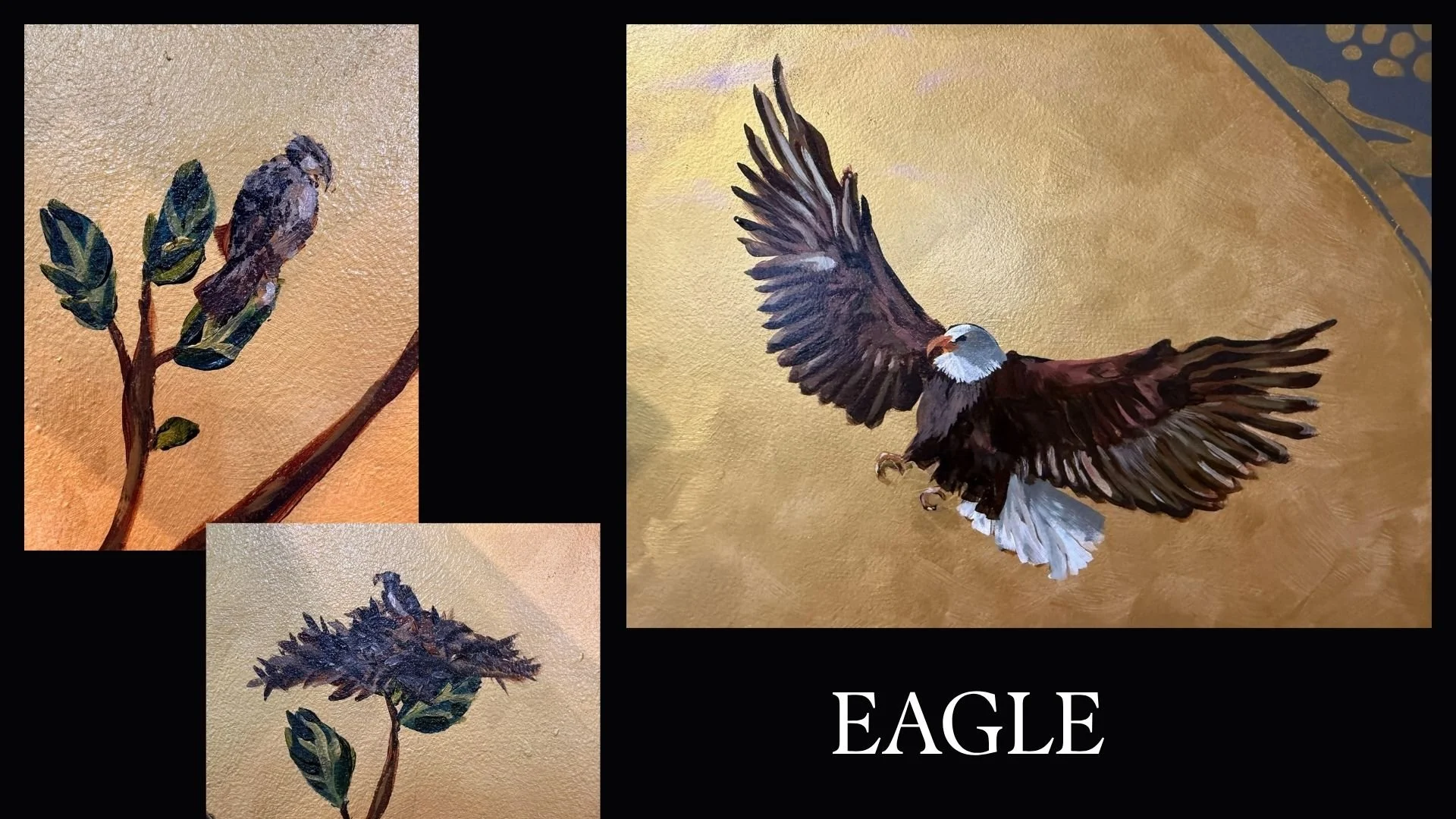
The eagle: Ex 19:4 “How I bore you on eagles wings”; Isaiah 40:31“but those who wait for the Lord shall renew their strength, they shall mount up with wings like eagles.” It is also a symbol of St. John. The book of Revelation describes one of the four creatures as an eagle (Rev. 4:7).
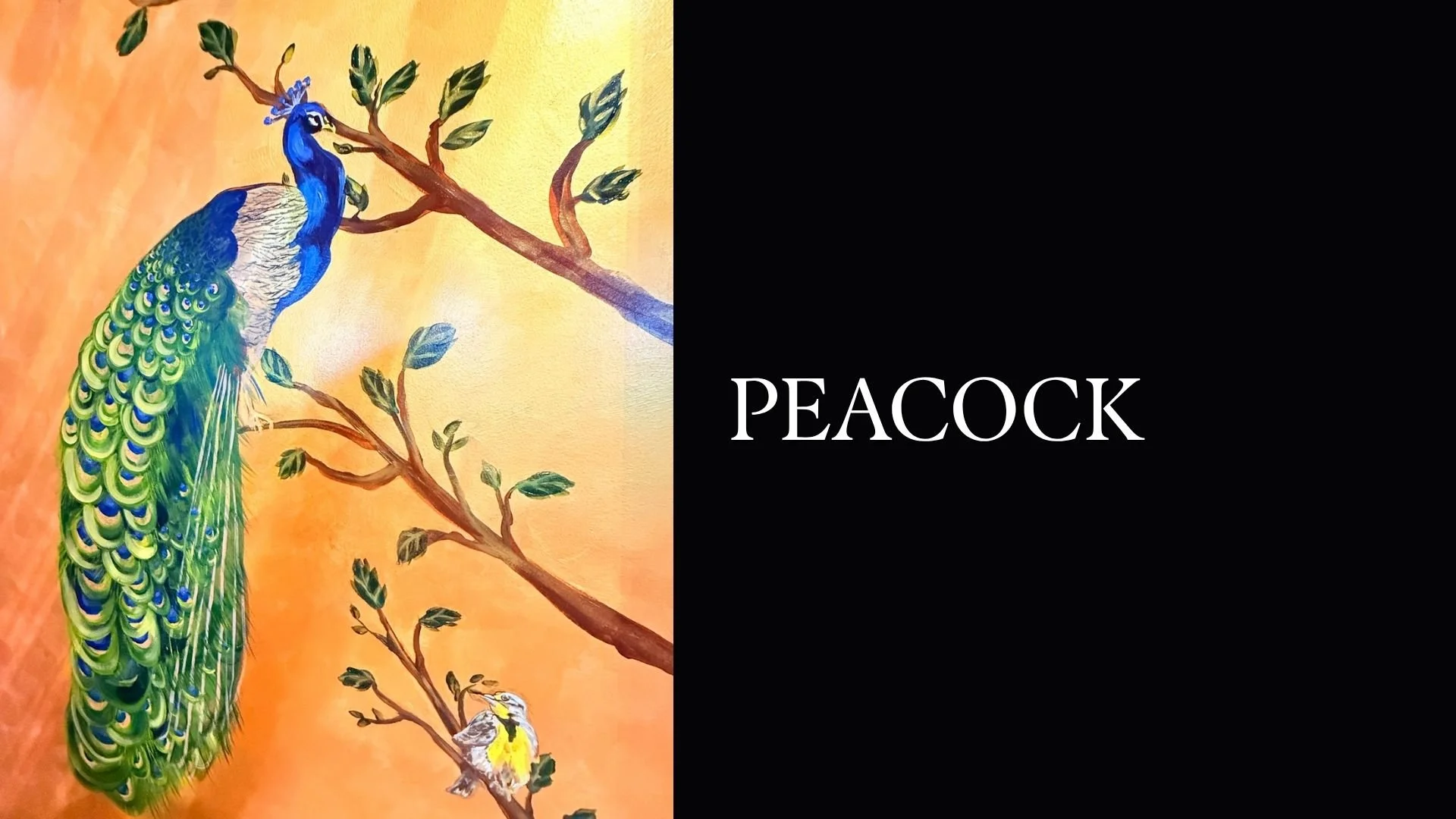
The peacock: a symbol of eternal life. It was believed that the flesh of the peacock would never decay. St. Augustine wrote about it in his City of God. “For who but God the Creator of all things has given to the flesh of the peacock its antiseptic property?”
The lark (Medow Lark): This was St. Francis’ favorite bird. He loved its song, and saw it as an act of praise to God. The hooded lark appeared to Francis to be wearing a hood, like a monk.
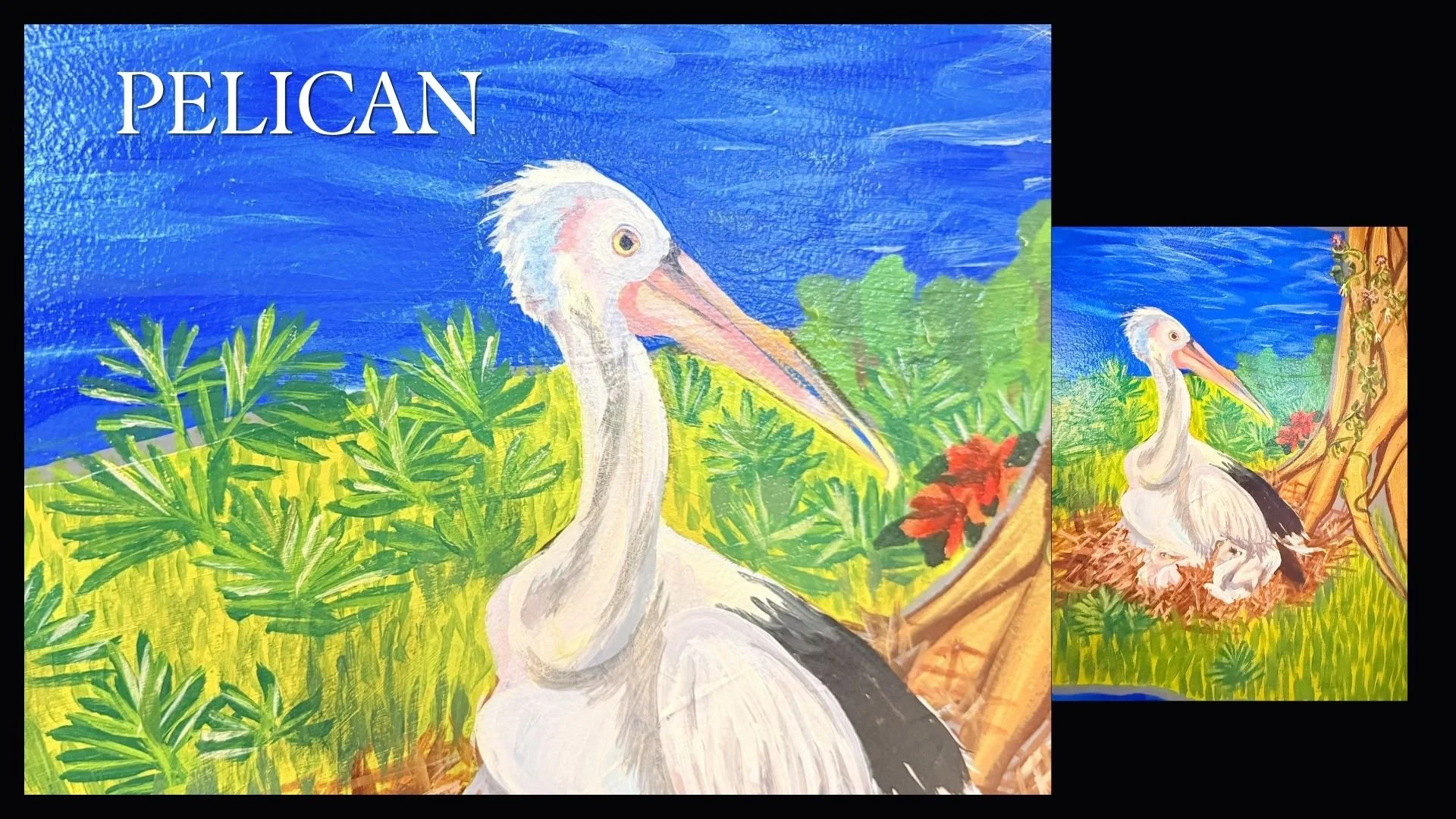
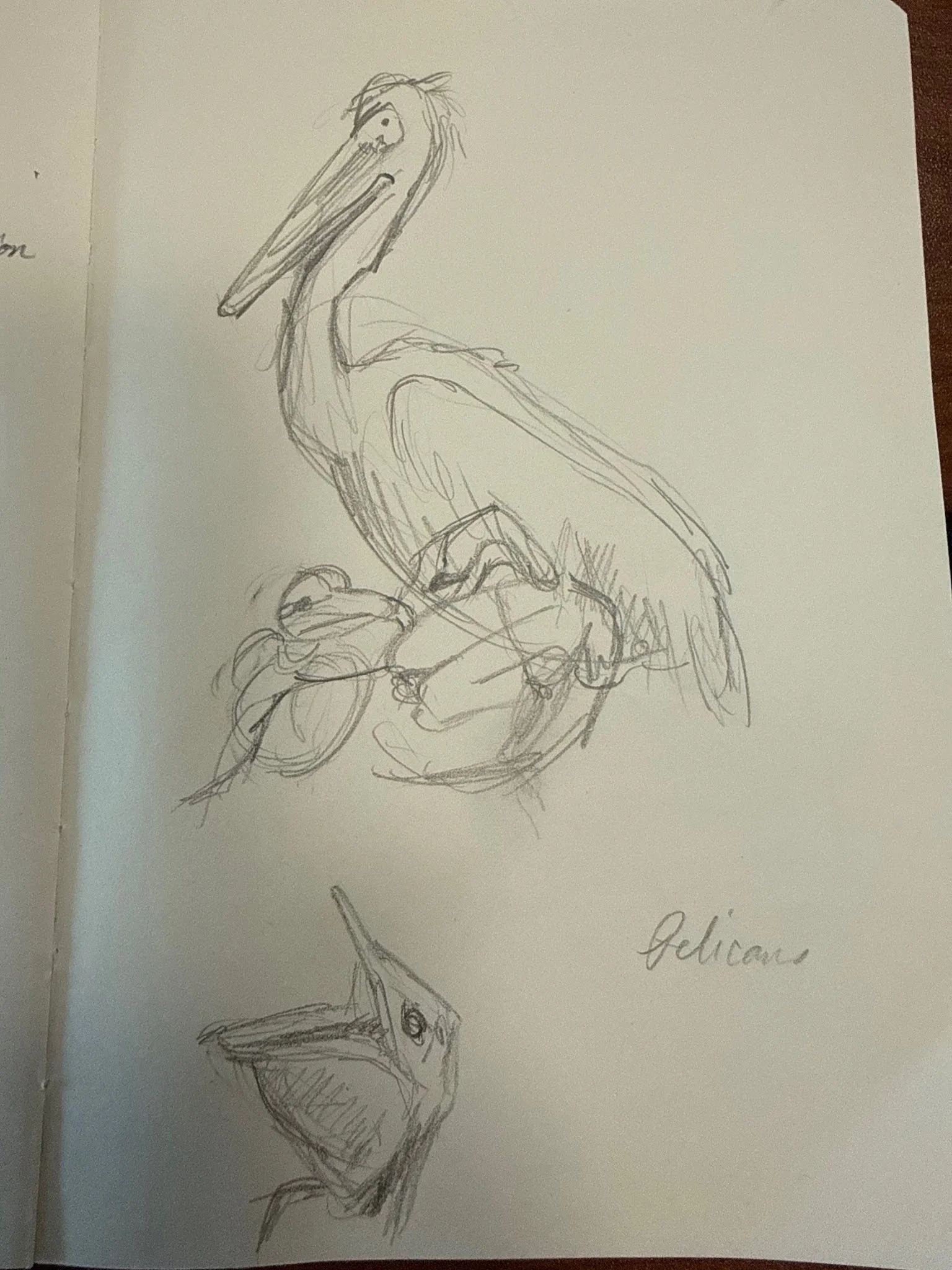
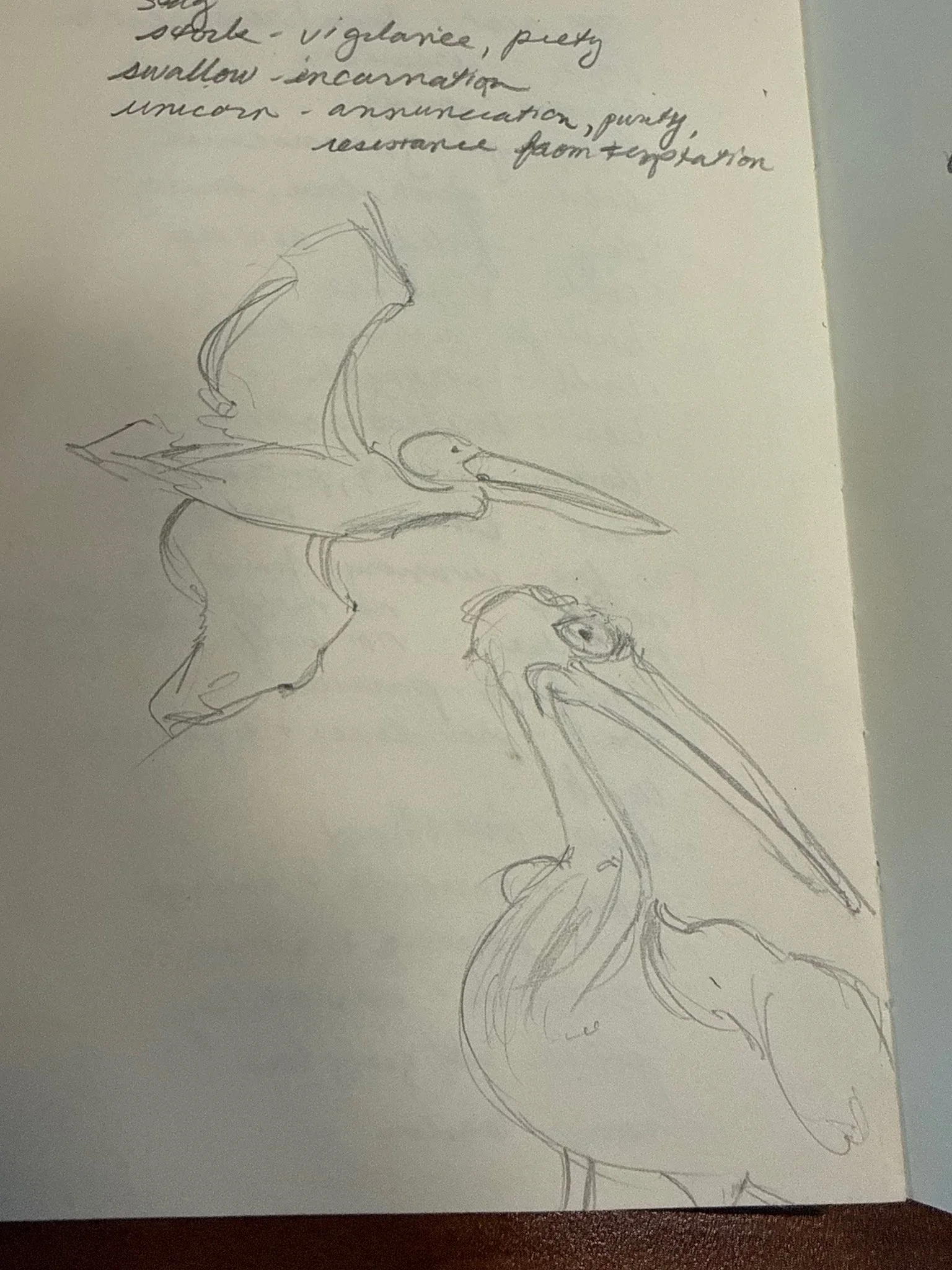
The pelican: It was believed that pelicans would wound their own flesh to feed their young, so the pelican became a symbol of the Eucharist, as Christ feeds us his own body and blood.
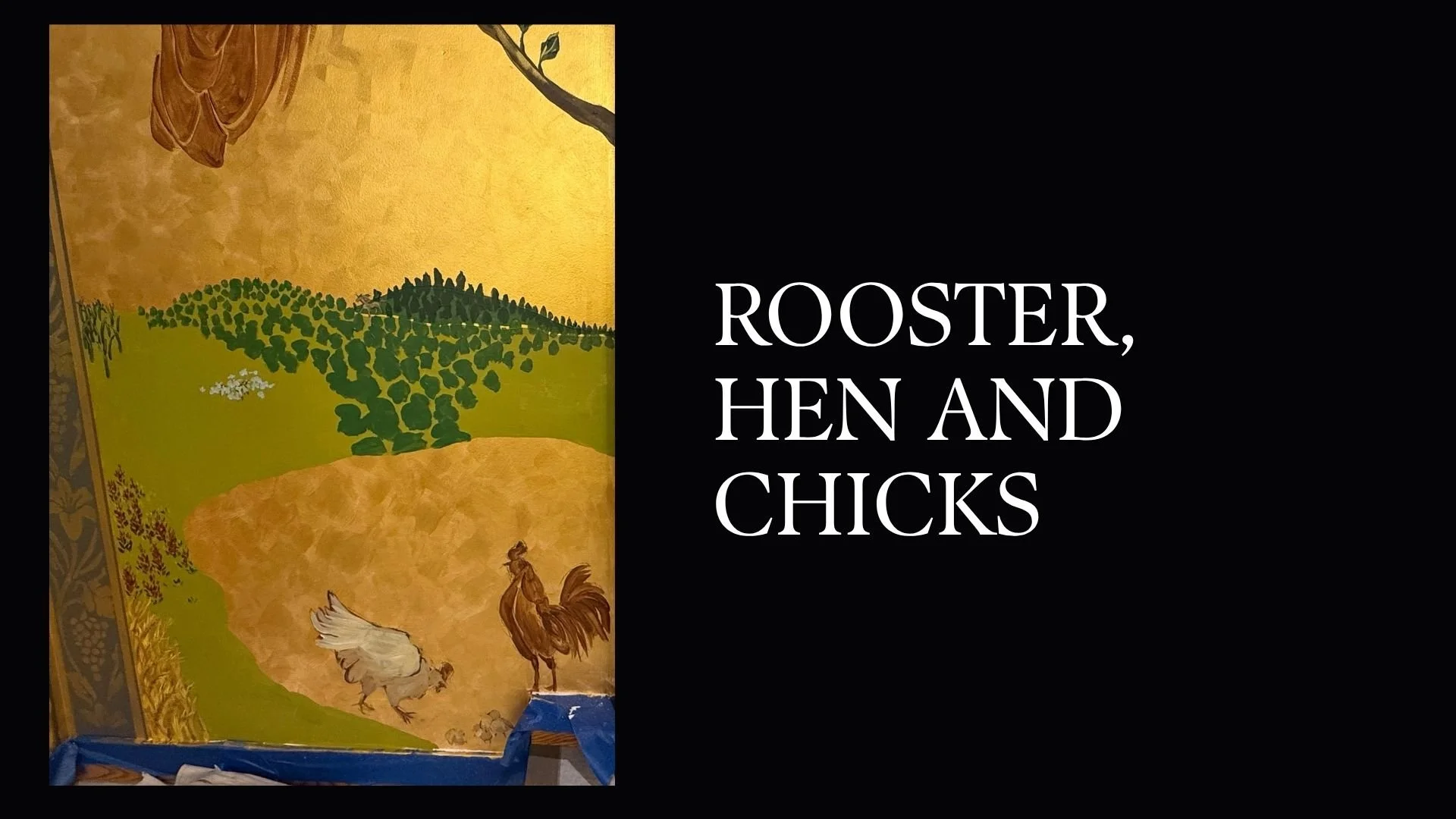
The rooster: Mentioned in the bible in connection with Peter’s denial. The Rooster has also traditionally been associated with announcing the rising of the sun, and so as a symbol proclaiming Jesus’ kingship.
The hen with her chicks: As Christ approaches Jerusalem, he laments: “...How often would I have gathered your children together as a hen gathers her brood under her wings, and you would not!” (Matthew 23:37).
The crane: A symbol of vigilance. In medieval bestiaries and Christian art, the crane was believed to stand on one leg while holding a stone in the other claw during the night. If the crane began to drift off to sleep, the stone would drop, making a sound and waking the bird up to resume its watch.
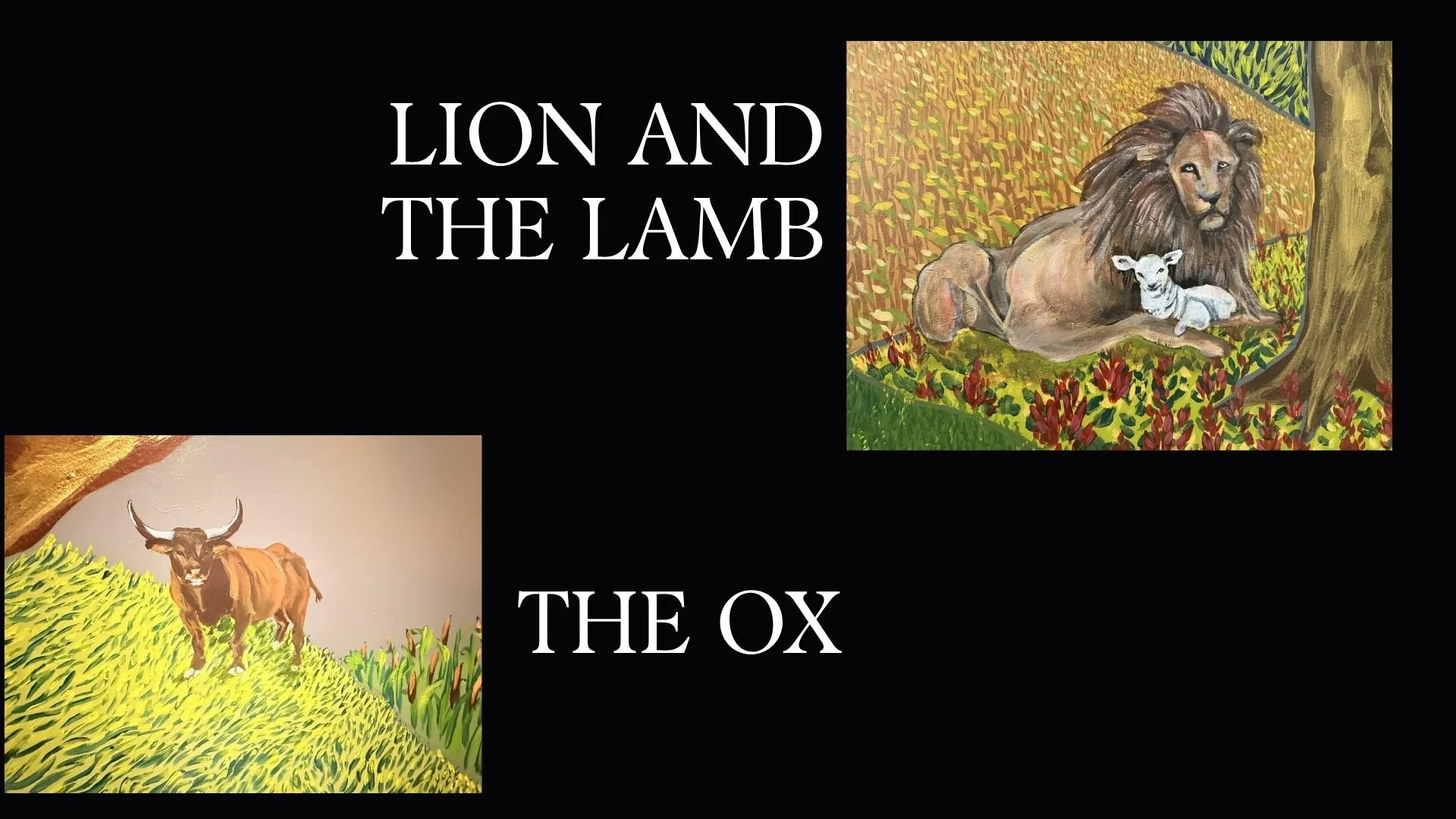
The lion and the lamb: The famous phrase "the lion shall lie down with the lamb" is a popular misquote, as the actual Bible text in Isaiah 11:6 states that "the wolf shall dwell with the lamb". But the imagery is still powerful as both the lion and the lamb are used as symbols for Jesus “Weep not; lo, the Lion of the tribe of Judah, the Root of David, has conquered” (Rev 5:5), “And between the throne and the four living creatures and among the elders, I saw a Lamb standing, as though it had been slain.” (Rev 5:6) . The lion is also a symbol for St. Mark the evangelist, as the book of Revelation describes one of the four creatures to be a winged lion (Rev 4:7)
The Bull/Ox: Represents St. Luke the Evangelist, as St. Luke’s gospel emphasises the sacrifice and priesthood of Jesus, and the ox was an animal of sacrifice. It is also mentioned in the book of Revelation as one of the four creatures (Rev 4:7).
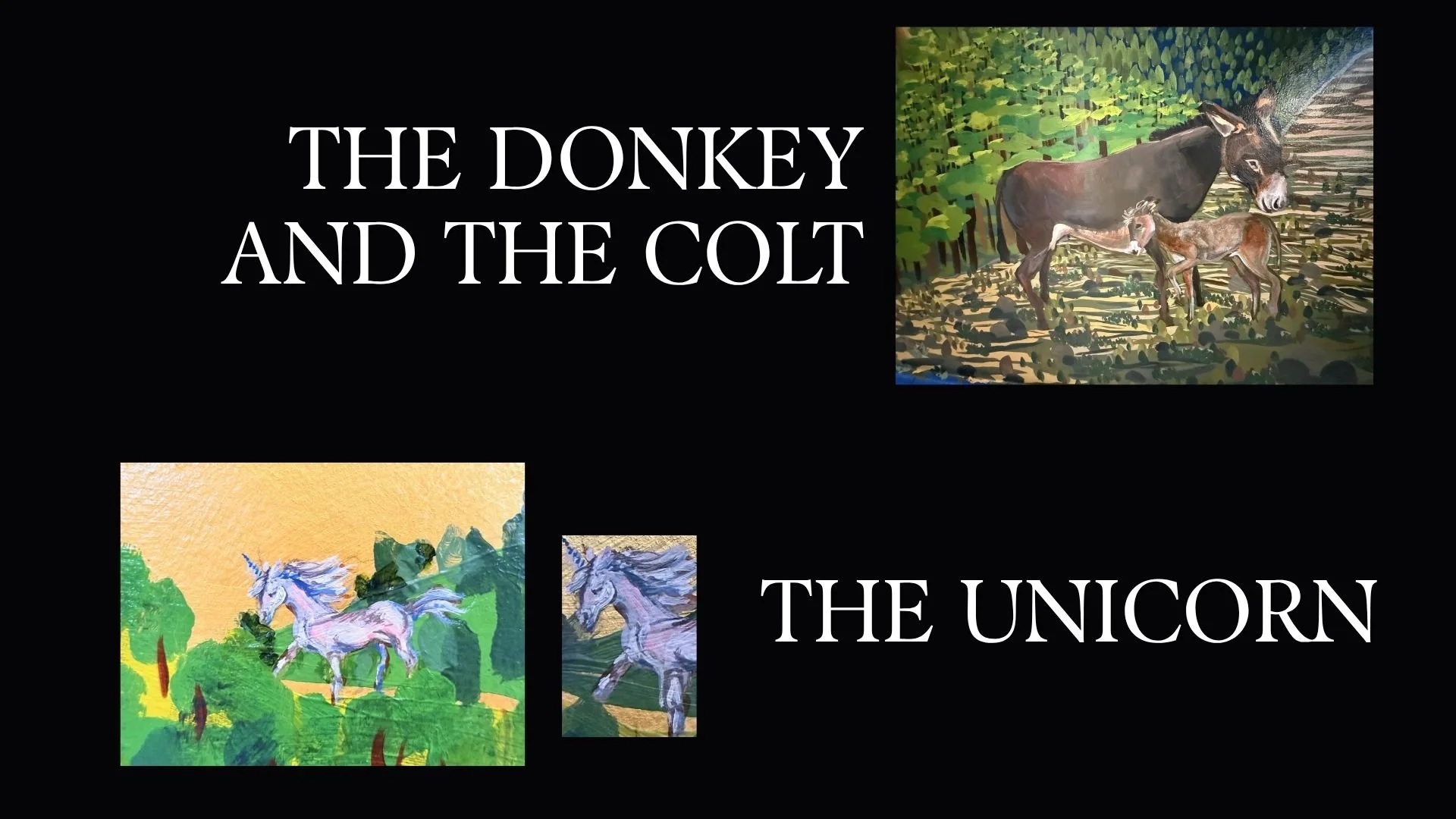
The donkey and the colt: St. Matthew describes how Jesus instructed his disciples to “Go into the village opposite you, and immediately you will find an ass tied, and a colt with her; untie them and bring them to me”. Jesus rode this donkey into Jerusalem on Palm Sunday, fulfilling the prophecy of Zechariah.
The Unicorn: In the medieval world, the unicorn actually symbolized the Incarnation. The unicorn symbolizes Christ and the virginal maiden associated with it represents his mother the Virgin Mary. The piercing of the unicorn's side, which is often portrayed in art, serves as an allegory for Christ’s death. Some older translations even use the word unicorn (Num 23:22, Job 39:9-12d), while modern translations mention an ox. “There is no perfect word in Hebrew that translates to the word ‘unicorn’. The Latin vulgate gave us this word to describe what most people in the ancient and medieval world believed to be a real animal that resembled a rhinoceros but looked more like a horse.” (from Catholic 365)
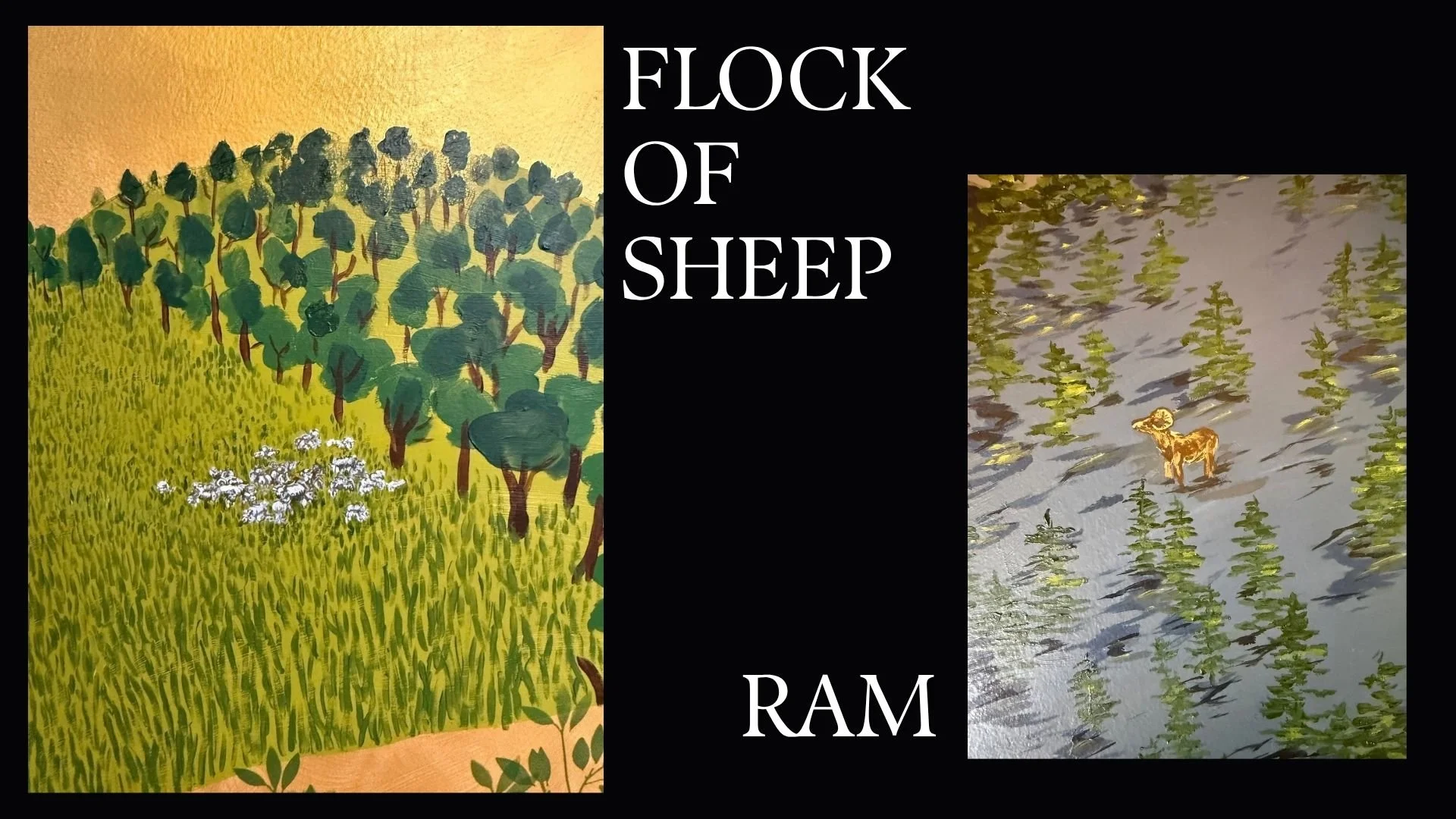
The Flock of Sheep: it represents all of us, allowing Jesus the Good Shepherd to lead and care for us. (John 10:14)
Ram: In Genesis 22:13, God provides a Ram to be sacrificed in place of Isaac, foreshadowing how he would later provide his Son, Jesus, as the Lamb of God, the most perfect sacrifice, to atone for our sins.

“The Adoration of the Magi”, by Bartolome Steban Murillo
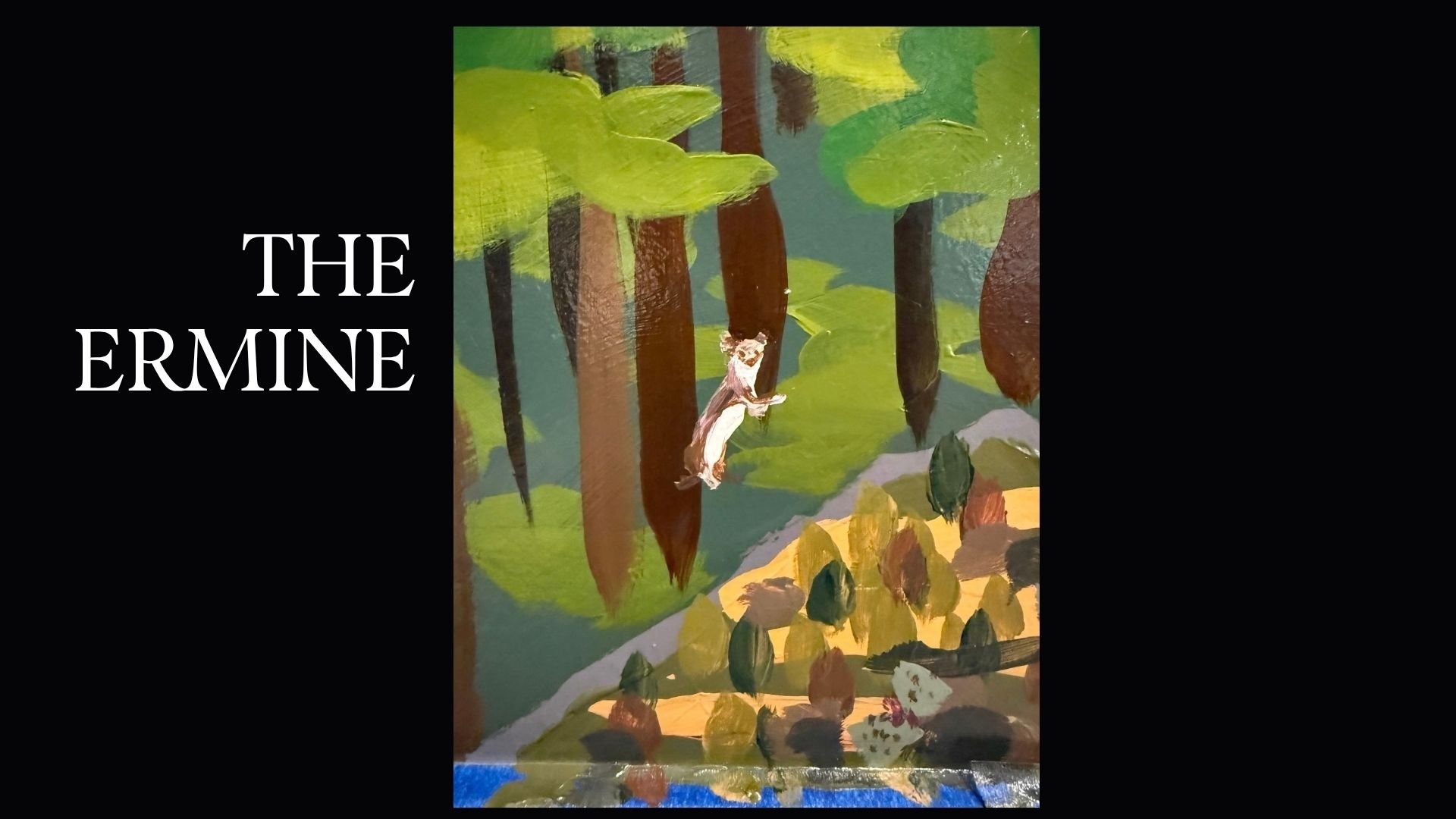
The Ermin: Because of its pure white fur the ermine became a symbol of moral purity and innocence. The ermine’s fur was attached to the robes and cloaks of royalty. The Adoration of the Magi by Bartolome Steban Murillo portrays a king (presumably one of the three wise men) adoring the newly born Jesus, weaning a coat made with ermin fur.
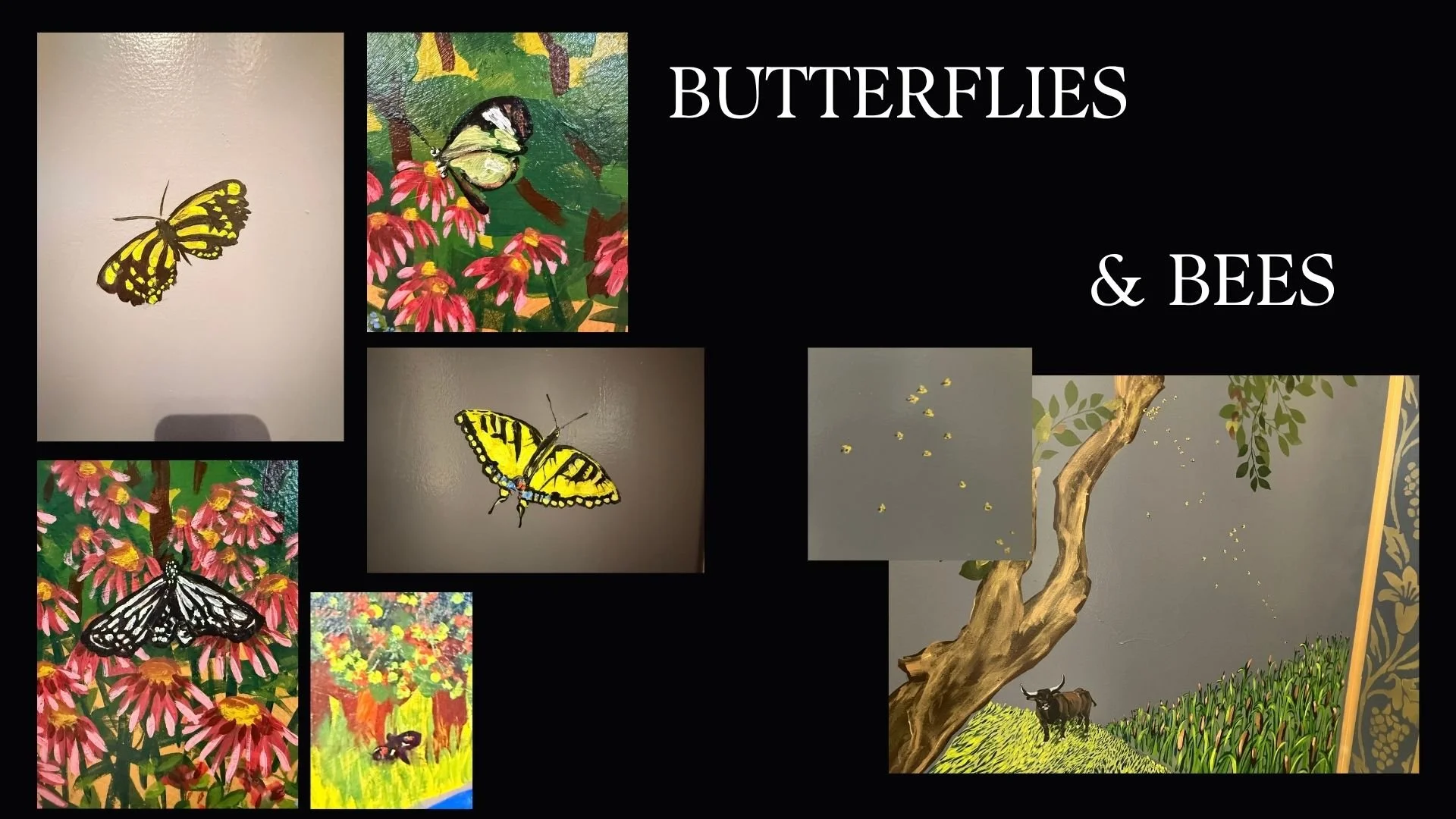
Butterflies: Great Catholic mystics like Saint Teresa of Ávila used the butterfly and its transformation as an analogy for the soul's journey from conversion to holiness.
Bees: Pure beeswax is traditionally used for liturgical candles, especially the Paschal Candle. The pure wax represents Christ's untarnished flesh, while the flame symbolizes His divine light dispelling the darkness of sin. The Exsultet hymn, sung during the Easter Vigil, explicitly mentions the "work of bees" in producing the wax that forms the Easter candle. The honey they produce is also a symbol of God’s goodness: “A land flowing with milk and honey” (Ex. 3:8). “How sweet are thy words to my taste, sweeter than honey to my mouth!” (Psalm 119:103)
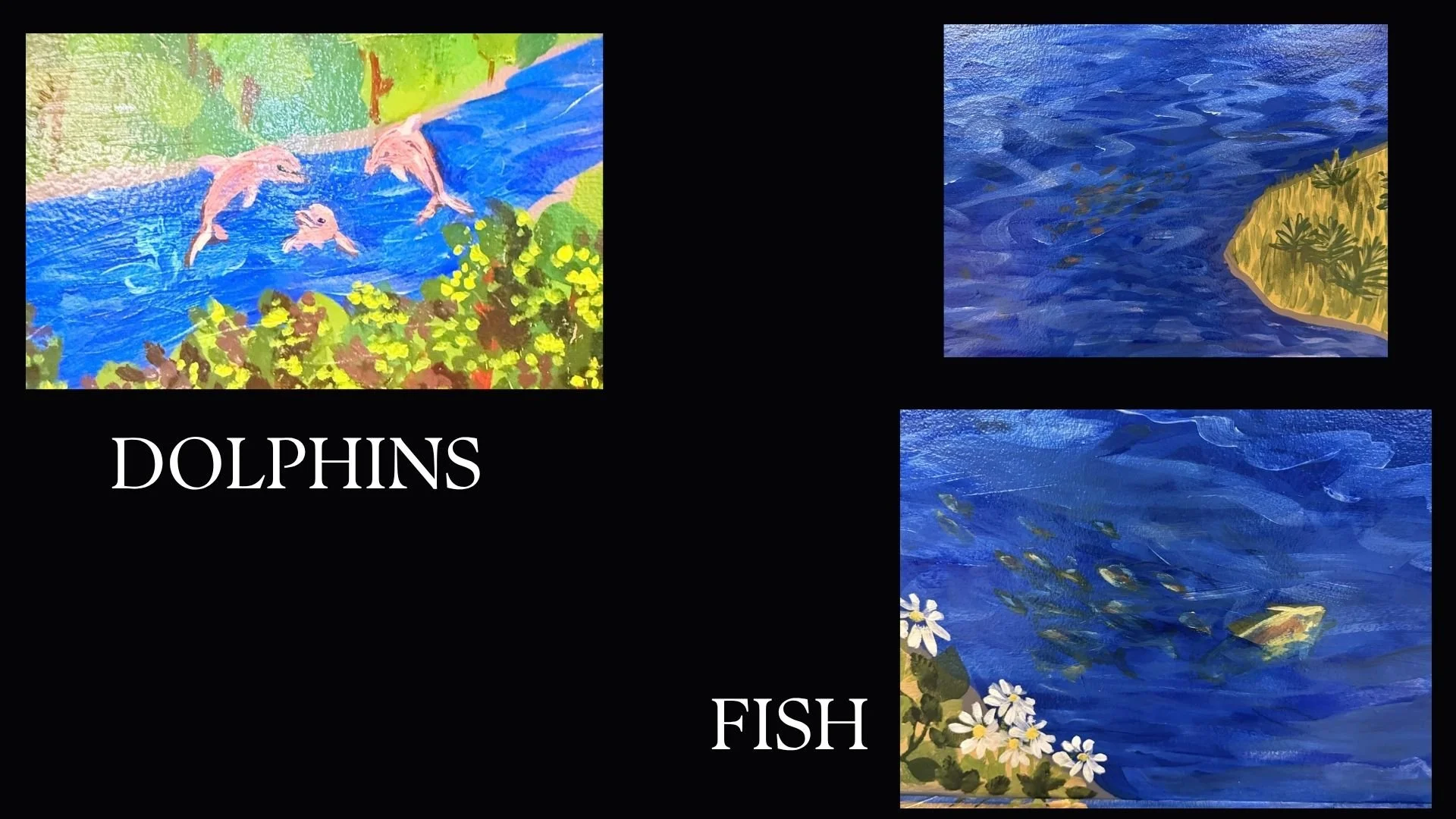
The fish (rainbow trout): The fish was originally used by the persecuted Christians in Roman times to mark the tombs of Christians. It recalls Jesus’ call to Peter and Andrew, both fishermen, to be fishers of men. (Mark 1:17)
The pink dolphins. Dolphins had great meaning in the pagan world, and were eventually adopted by Christians. It was a widely used symbol in Christian iconography with varying meanings. Among them, it was understood by some as a symbol of Jesus Christ, as dolphins are friends to sailors on their journey home, so Jesus is our friend who helps us get to heaven. Why are they pink? Since a river is depicted in the mural, rather than an ocean, pink dolphins, who live in the freshwaters of the Amazon and Orinoco rivers, were a better choice of dolphin species.
Ants: Multiple mentions of the ant in the book of Proverbs, praising the ants for their prudence, diligence, and hard work: “Go to the ant, O sluggard; consider her ways, and be wise." (Prov 6:6)
FLORA
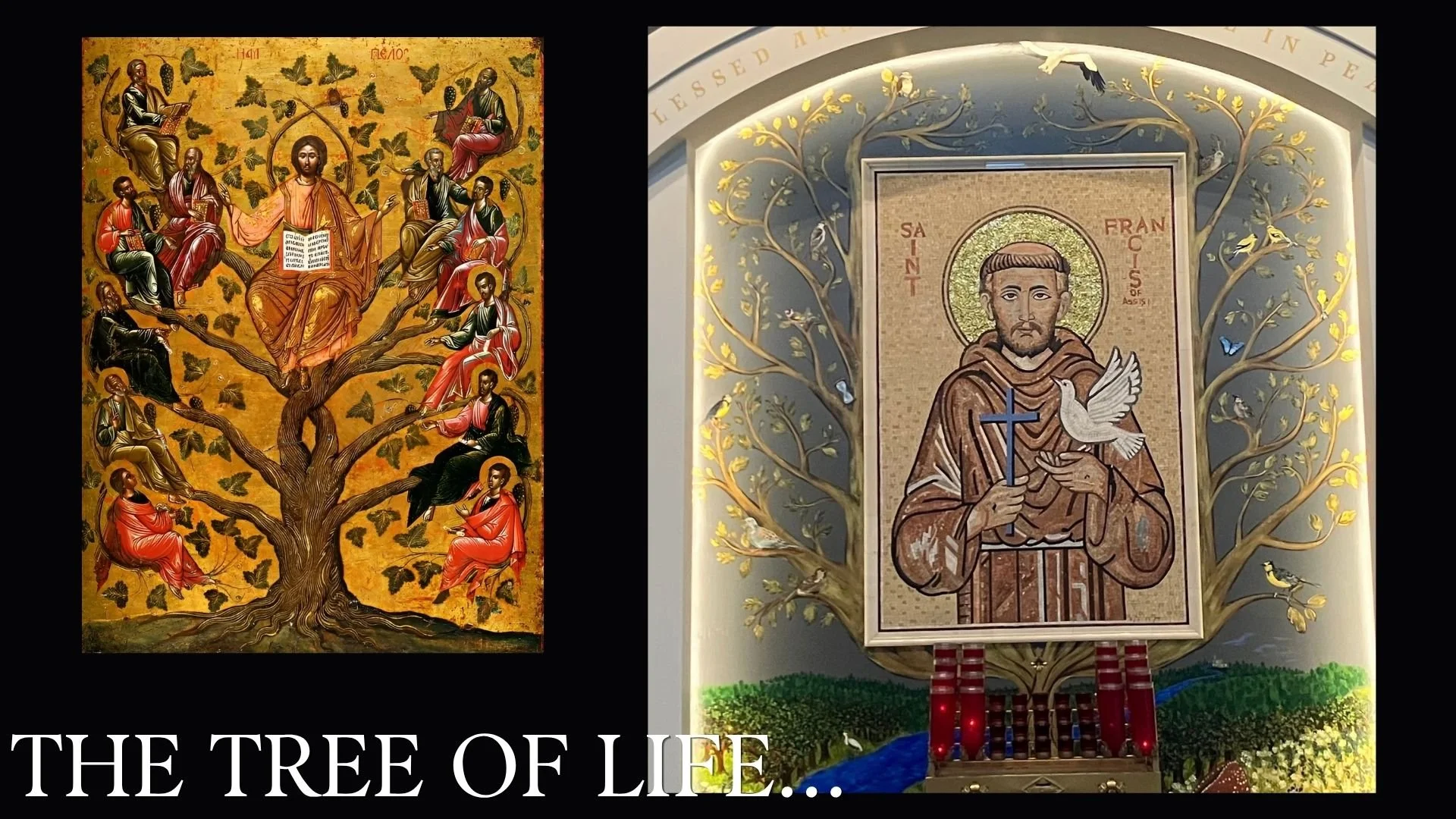
The Tree of Life. The central tree, behind and around the mosaic of St. Francis, is meant to remind us of traditional Eastern icons of the Tree of Life (Gen 22:9) as a prefiguration of Christ the True Vine: “I am the vine, you are the branches. He who abides in me, and I in him, he it is that bears much fruit, for apart from me you can do nothing.” John 15:5.
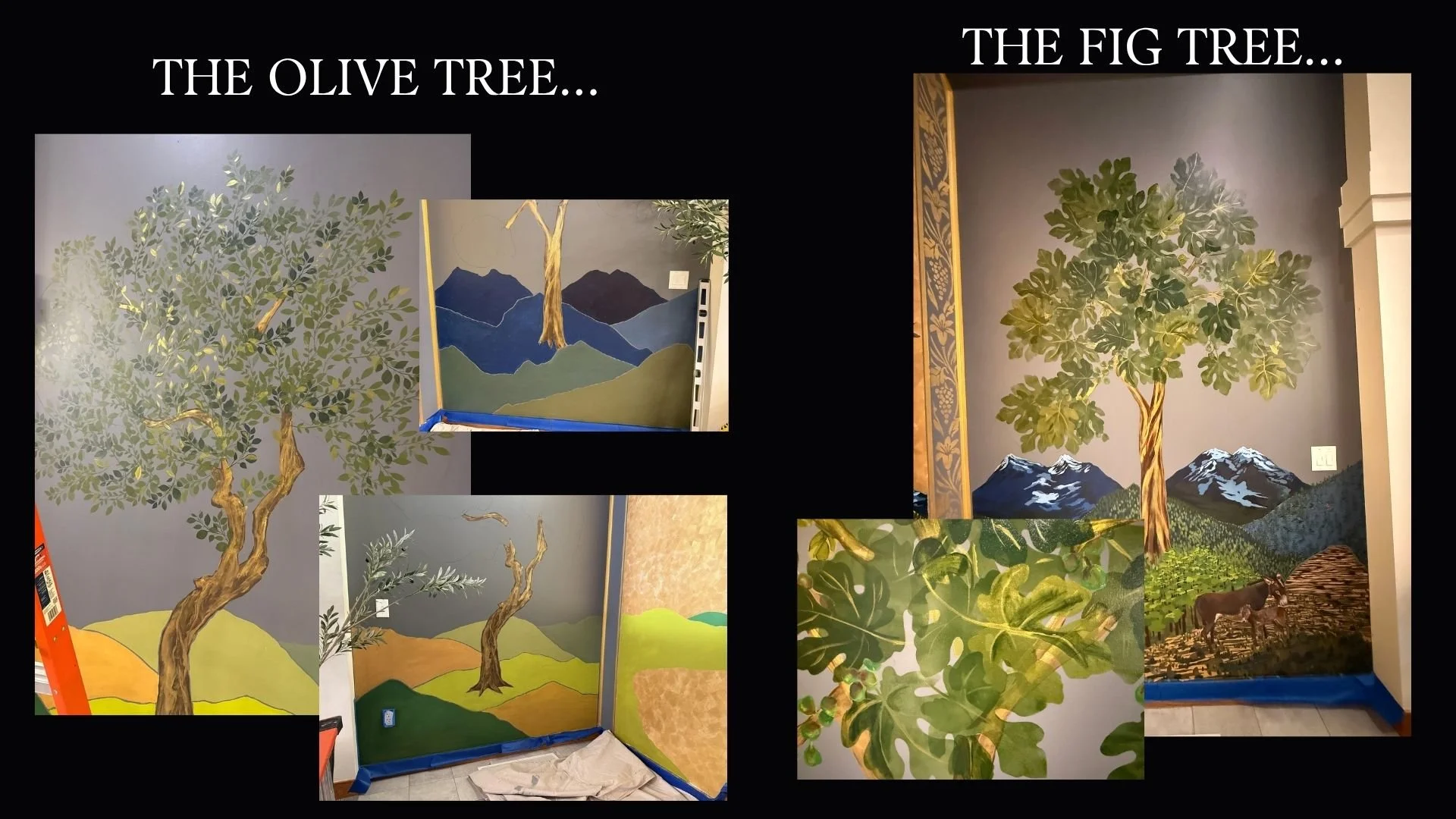
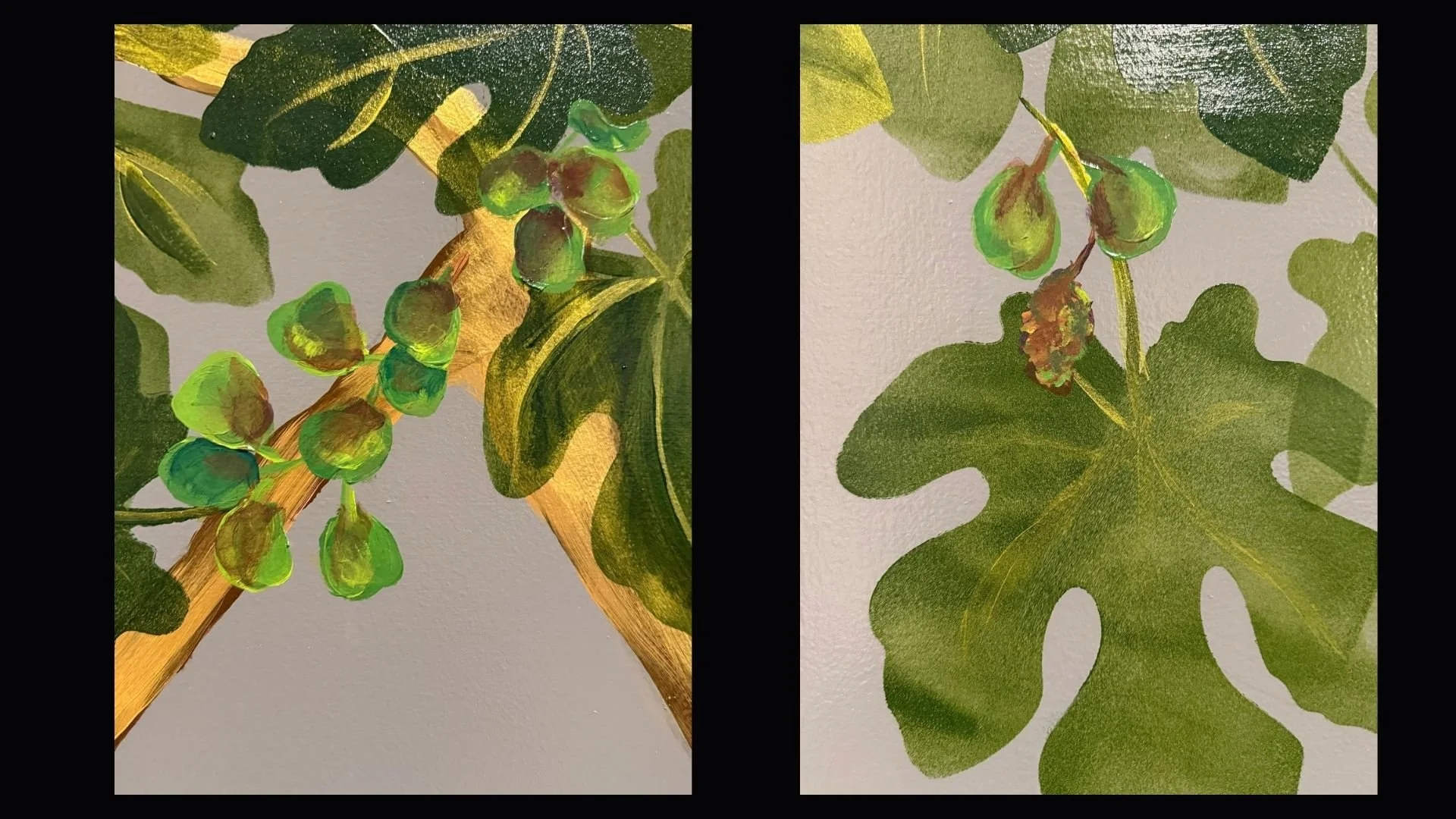
The Fig Tree. It is mentioned many times in the bible. After the Fall Adam and Eve covered their bodies with fig leaves: “Then the eyes of both were opened, and they knew that they were naked; and they sewed fig leaves together and made themselves aprons." (Gen 3:7). Nathaniel rests under a fig tree before being called by Phillip to meet Jesus. (John 1:47-50). Jesus offers a parable of the barren fig tree (Luke 13:6-9) and later curses a fig tree (Mark 11:12-14)
The Olive Tree: Symbol of Peace and God’s mercy. In Genesis, a dove brings back a fresh olive branch to signal to Noah that the flood has ended (Gen 8:11). Olive oil was used for the Temple’s lamps, and has been used for centuries (even today) for sacramental anointings.
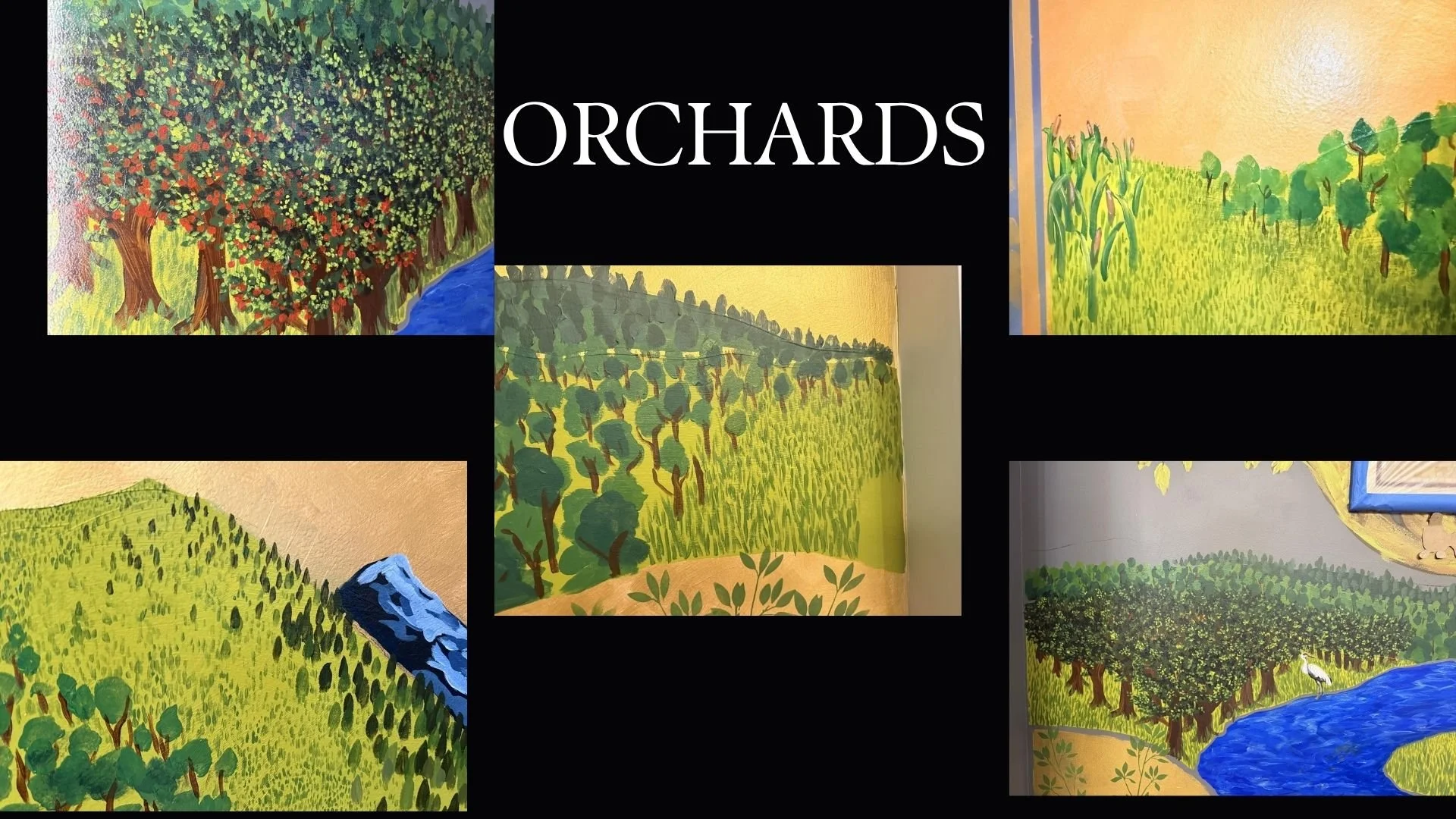
The orchards: (see note on the River) Includes apples, pears, cherries, plums, peaches, grapes.
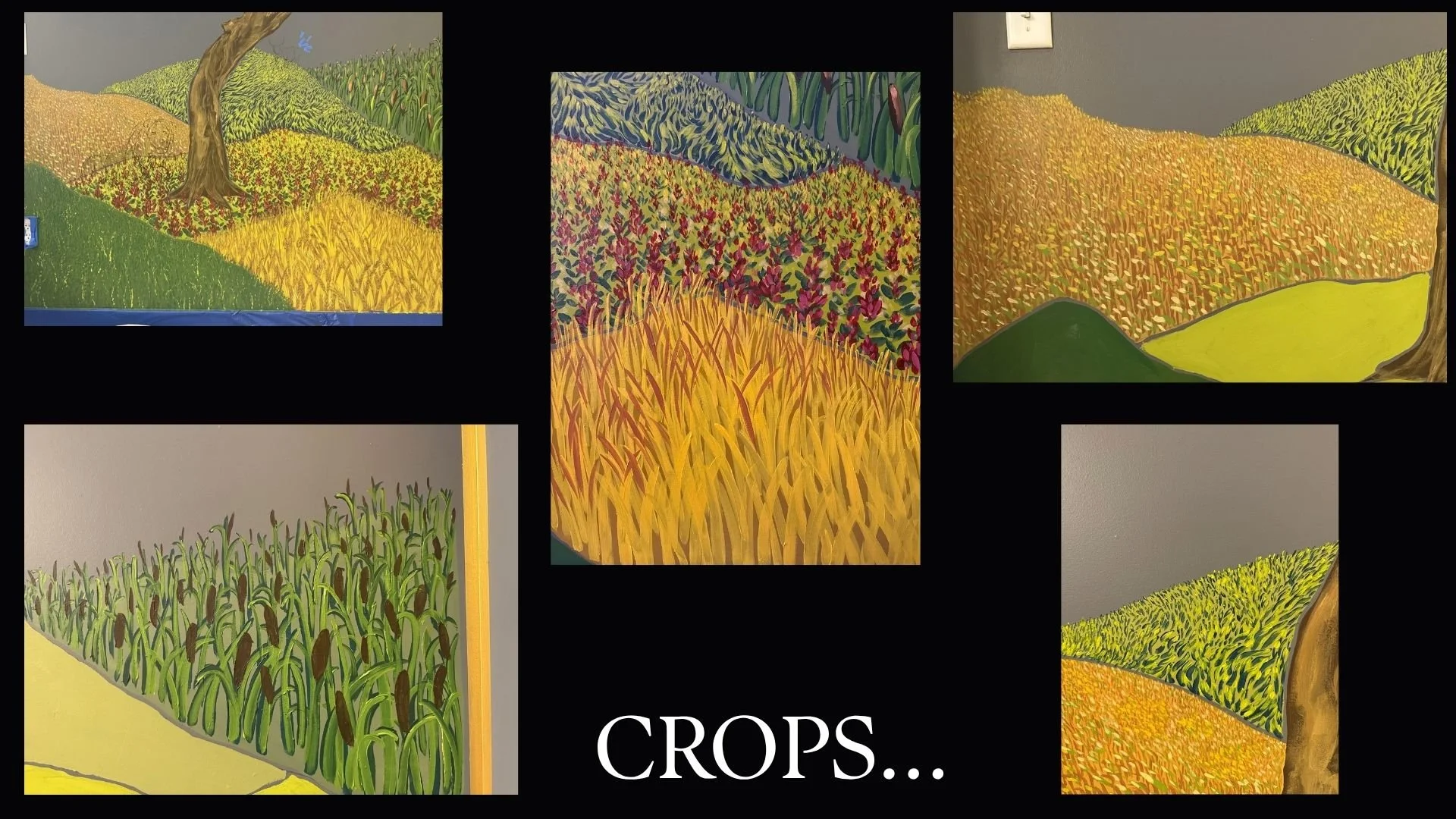
The crops: Wheat, Barley, Spelt and Millet are ancient grains, mentioned in the book of Ezequiel (Ezekiel 4:9). Amaranth is an ancient grain but from the Americas, while Teff is an ancient grain from Ethiopia. Combined they reinforce the idea of the global reach of St. Francis’ ministry. Mint, dill, and cumin are mentioned on Matthew (Matthew 23:23). A Hyssop branch was to be used on the first Passover to mark the doorposts with the blood of the Passover lamb (Ex 12:22); later, priests used hyssop to sprinkle blood during the purification rituals (Lev 14); King David referred to this ritual, “Cleanse me with hyssop, and I will be clean…” (Psalm 51:7); When Jesus said “I thirst” from the cross, a Roman soldier offered him a sponge soaked with vinegar on the end of a branch of hyssop (John 19:28-30).
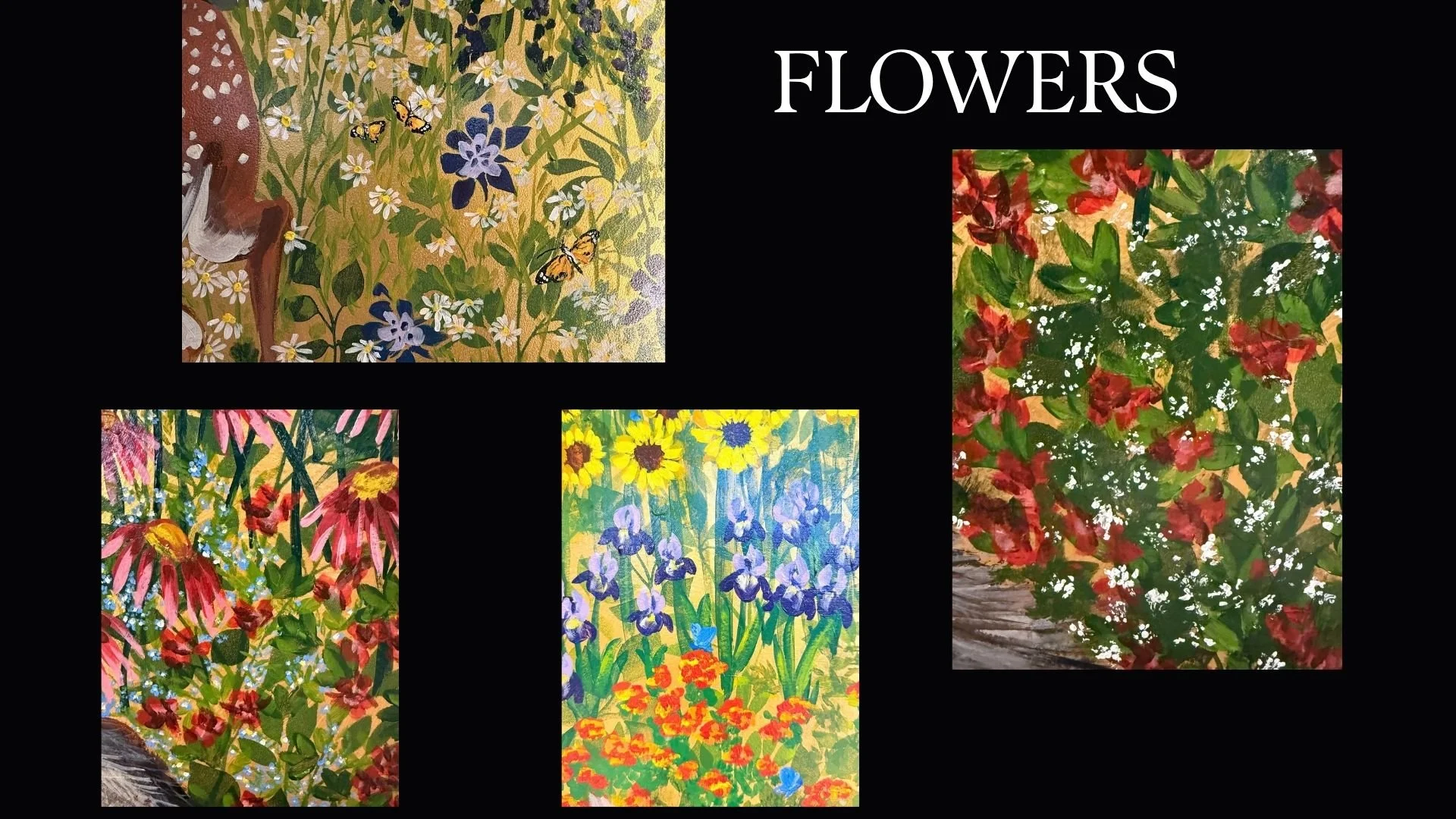
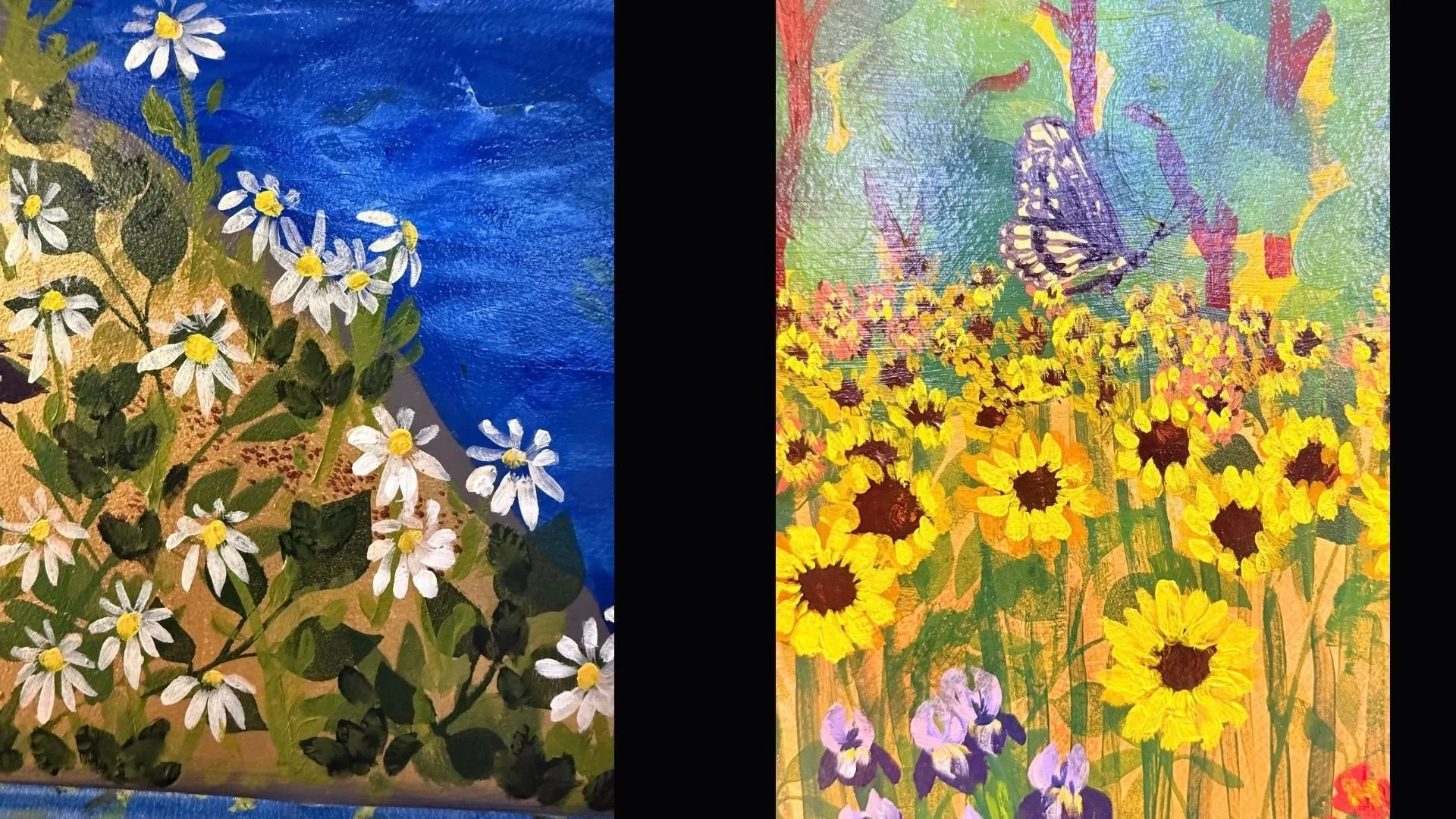
The flowers: Daisies, Columbines, Pointettias, Marigolds, Sunflowers, Purslane, Irises, Forget-Me-Not, Cone Flowers, Wild Roses, Snapdragons. The “passion flowers” right behind the pelican, climbing up the trunk of the tree of life, further symbolize Christ’s passion. Additionally, Jane added her husband and children’s favorite flowers as a way to sneak in a “family portrait”.
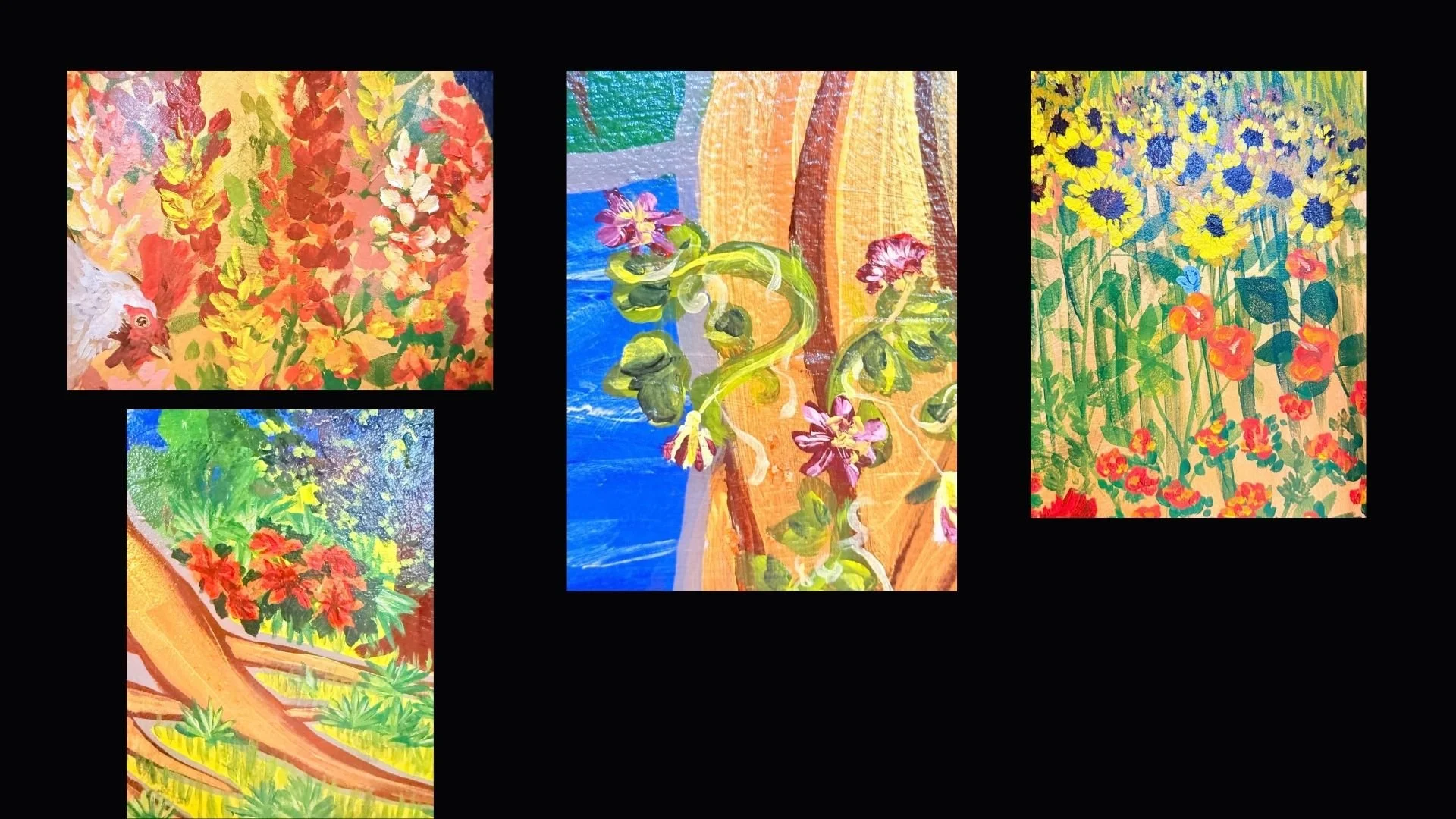
Landscapes:
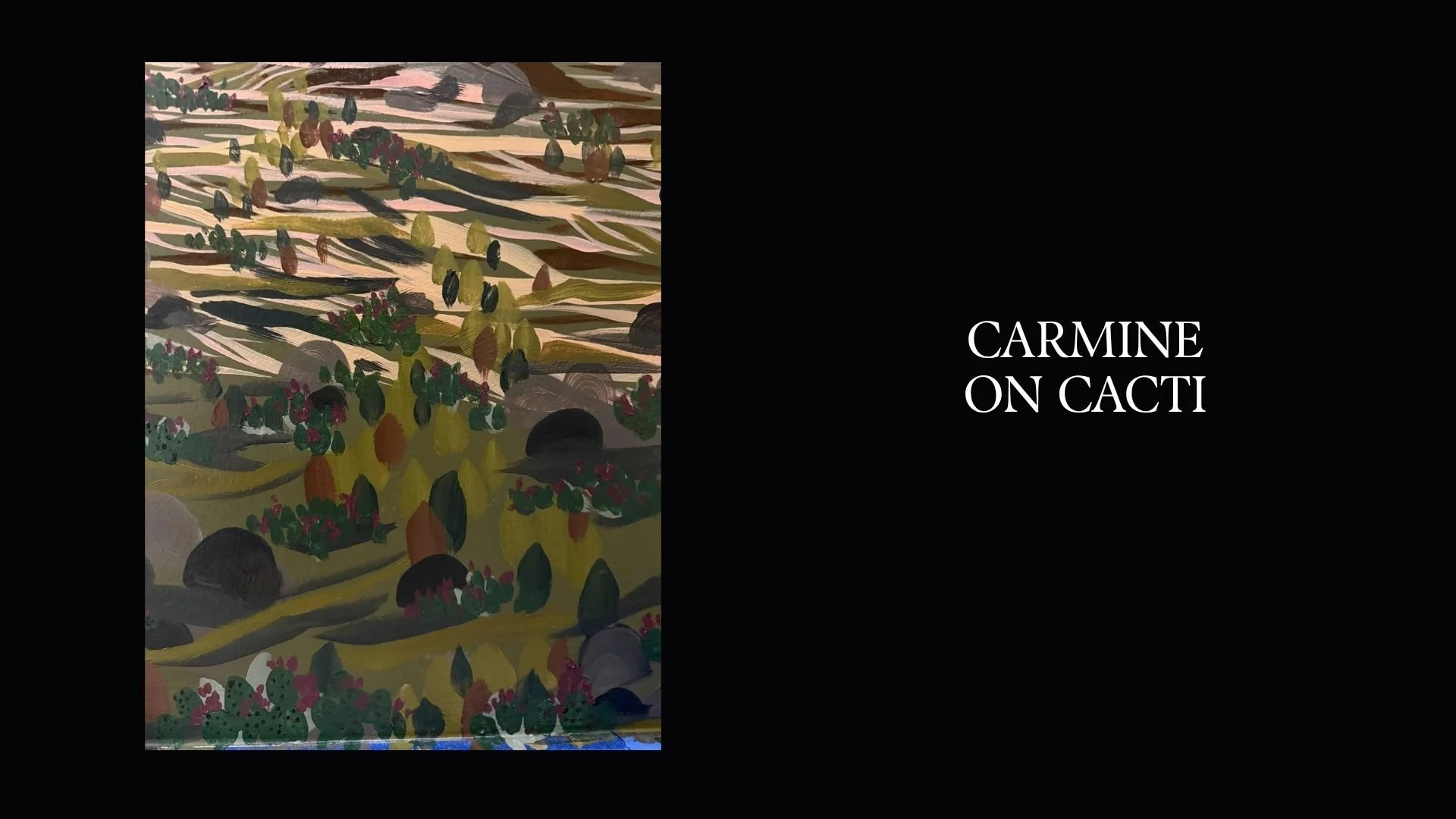
The desert: Great biblical symbolism with the Exodus of the people of Israel, and the temptations of Jesus. The desert also features Cacti covered with tiny red cochineal insects, known to produce a red dye called carmine, used traditionally for Cardinal’s vestments.
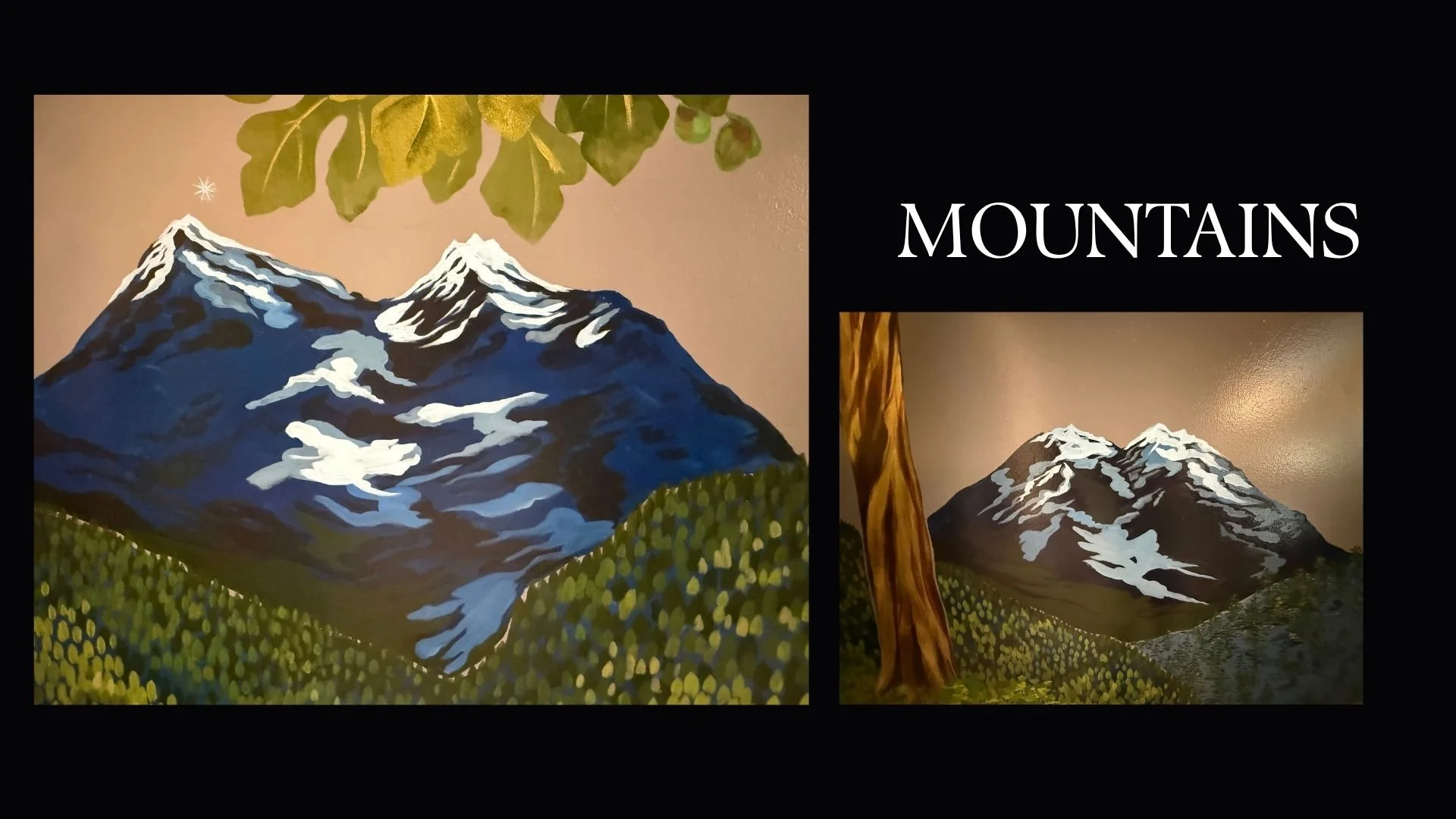
The mountains: Fir/Evergreens, Ponderosa Pines.
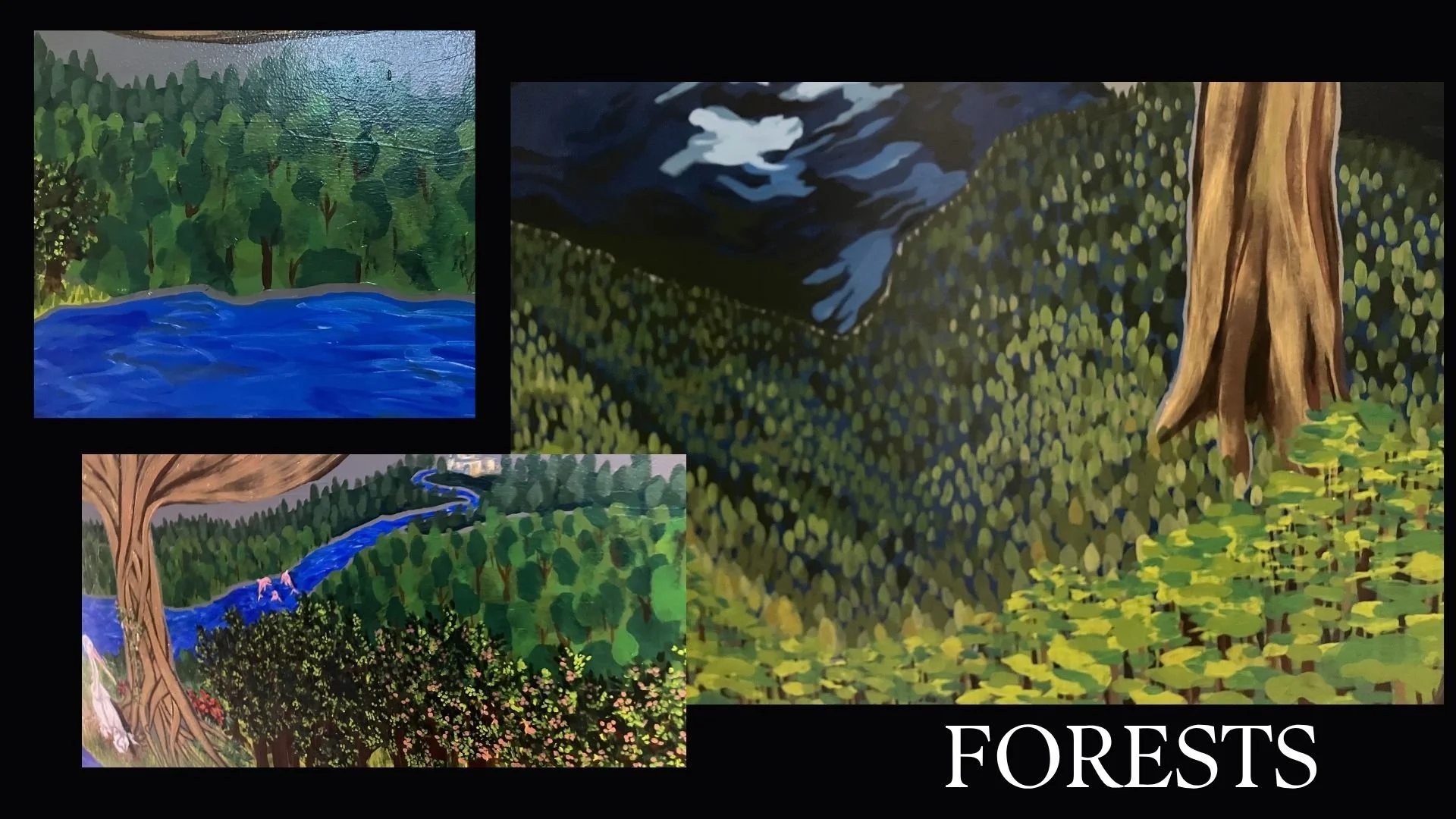
The central forests: Cypresses are typical of the Italian (Umbrian) landscape where St. Francis lived and preached.
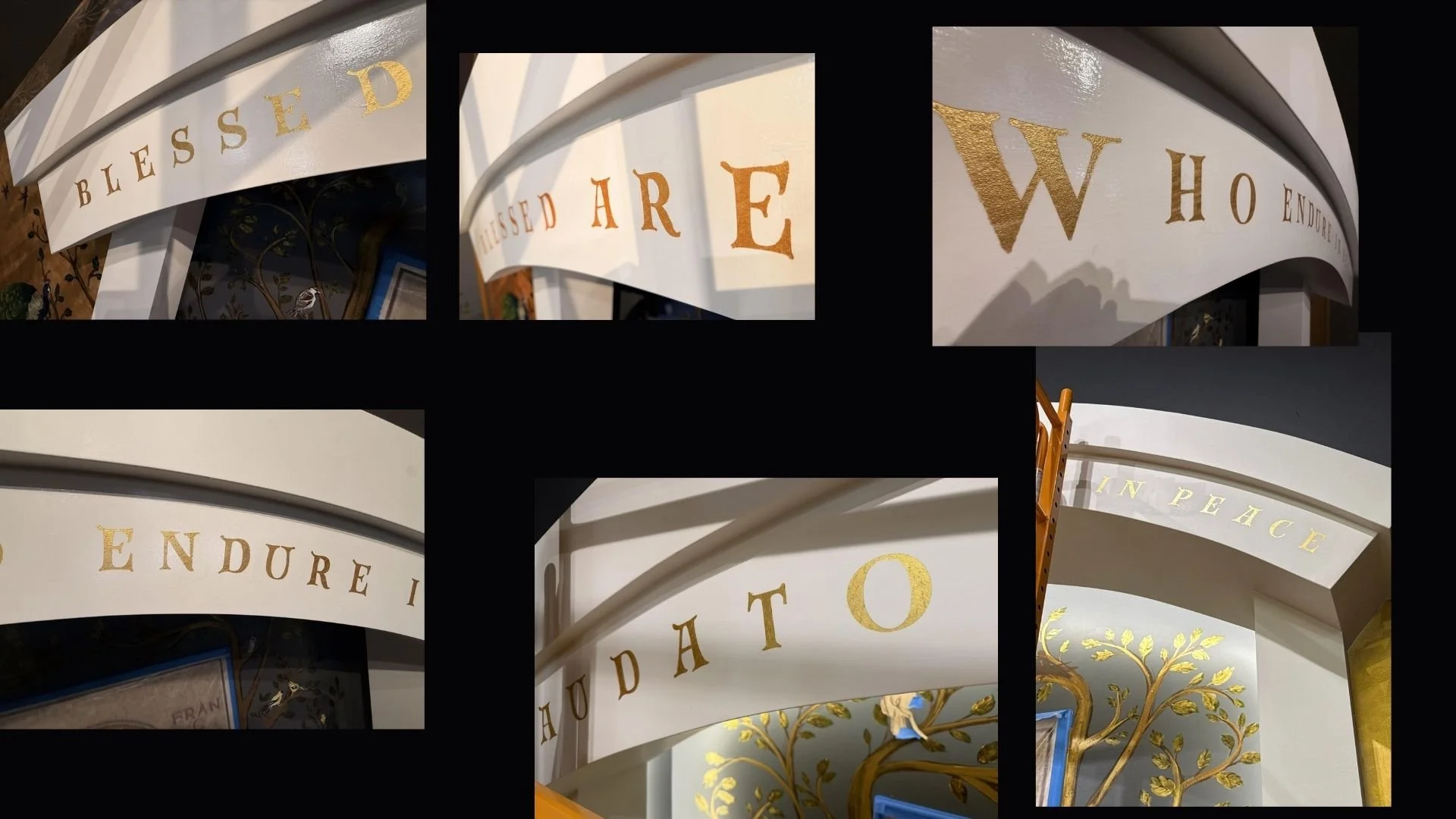
“Blessed are Those who Endure in Peace” - Inscription
St. Francis added a couple of paragrapha to his canticle as a way to help the major and Bishop Guido of Assisi to resolve a bitter dispute: “Praised be you, my Lord, through those who forgive for your love and who bear sickness and trial. Blessed are those who endure in peace, for by you, Most High, they will be crowned.”
Our original title for the piece was “Laudate Si, Mi Signore”, the opening words of the poem. Jane stenciled the words with gold on the arch above the mural. And yet, the Lord had other plans. One day, after reading the canticle once again, Fidel got a strong sense that the stenciled words should be “Blessed are those who endure in peace”. This kept being confirmed in prayer, so he took the proposal to Father Jim, Father Ryan, and other staff members. Eventually the team decided it was worth moving forward with the change. In early September, Father Juan Diego Sutherland, CFR came our parish to preach a parish mission for the Jubilee of St. Francis of Assisi. On his first homily he mentioned his delight to see these words written over the mural as his homily was based on them, thus confirming once again that this had been yet another movement of the Holy Spirit.
There is also a beautiful parallel between these words and the words written over Mary’s alcove on the opposite side of the church. “All generations shall call me blessed”, “Blessed are those who endure in peace”. Who lived the virtue of peaceful and patient endurance better than our Blessed Mother?
Sister Death
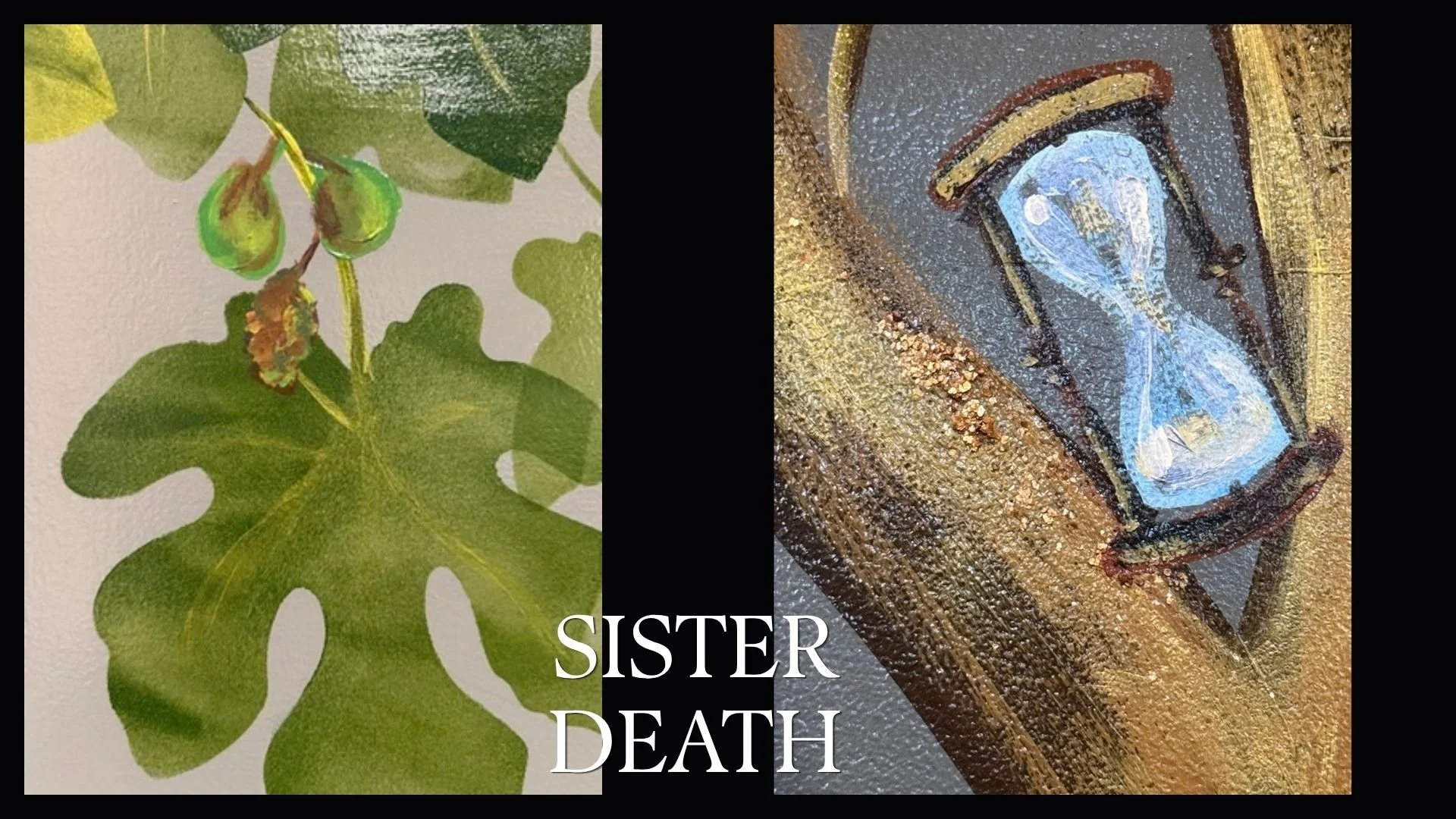
Sister death depited with the withered fig and the hour glass.
It is said that St. Francis would ponder on his death for hours (memento mori). In this mural there are two symbols for death. The hour glass on the branch, was a common medieval symbol to depict the passing of time and human mortality. The fig tree also features a withered fig, reminding us also of Jesus’ cursing of the fig tree.
Other Symbols
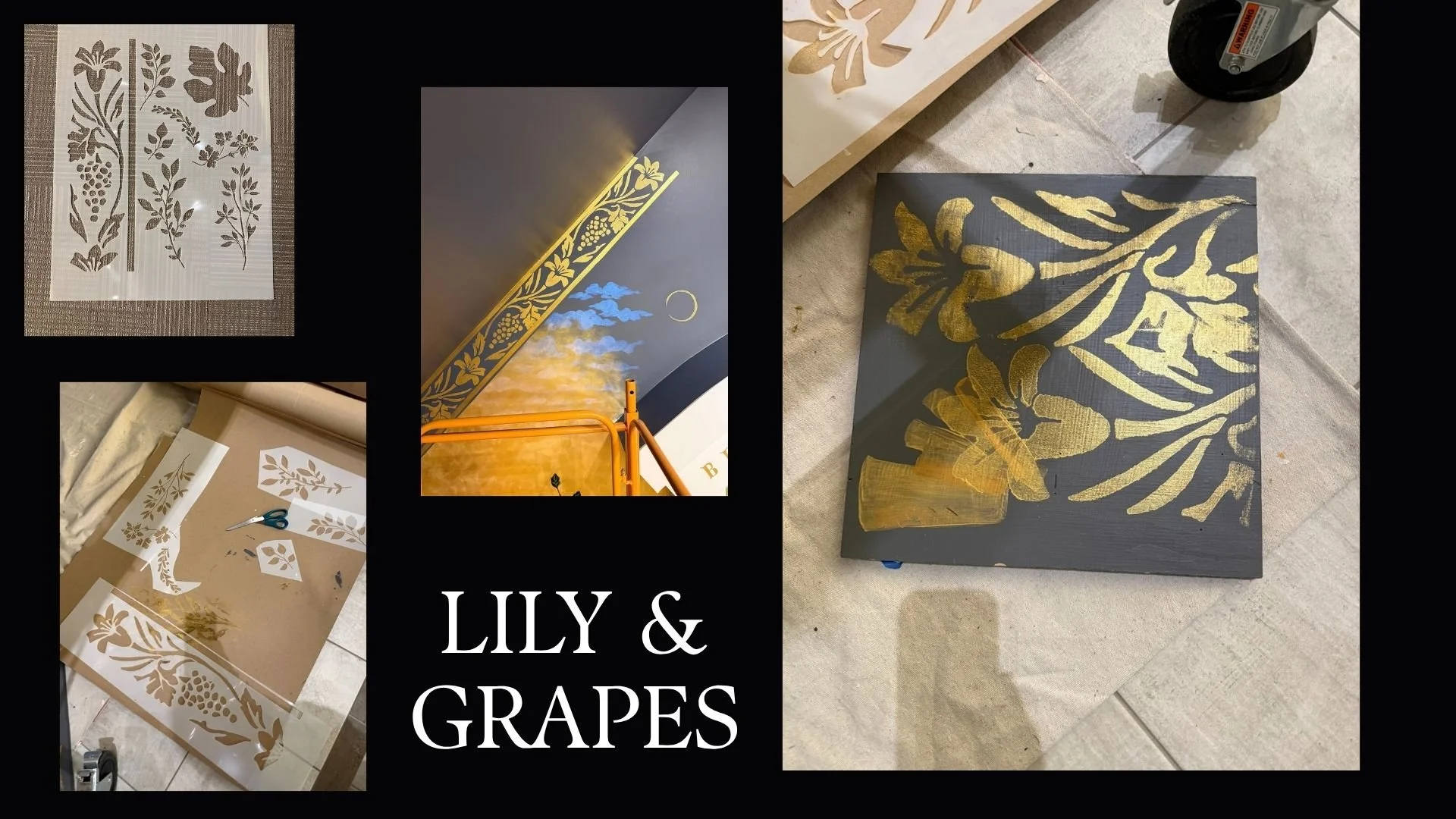
The stenciled border:
The Lily flower: A symbol of purity, traditionally associated with Our Blessed Mother Mary and St. Joseph. The “lily of the valley” is mentioned in the Song of Songs to poetically describe beauty and grace. Jesus echoes this when he asks “And why are you anxious about clothing? Consider the lilies of the field, how they grow; they neither toil nor spin; yet I tell you, even Solomon in all his glory was not arrayed like one of these.” (Mat 6:28-29). Lilies are used extensively in Easter decorations as they are also a symbol of resurrection.
The Vine/Grapes: A symbol for Jesus, as he describes himself as “the true vine” (John 15:1). Jesus’ first miracle was multiplying the wine at the Wedding at Cana (John 2:1-11). Grapes are used to produce wine, which is transformed into the Blood of Christ at Mass when consecrated.
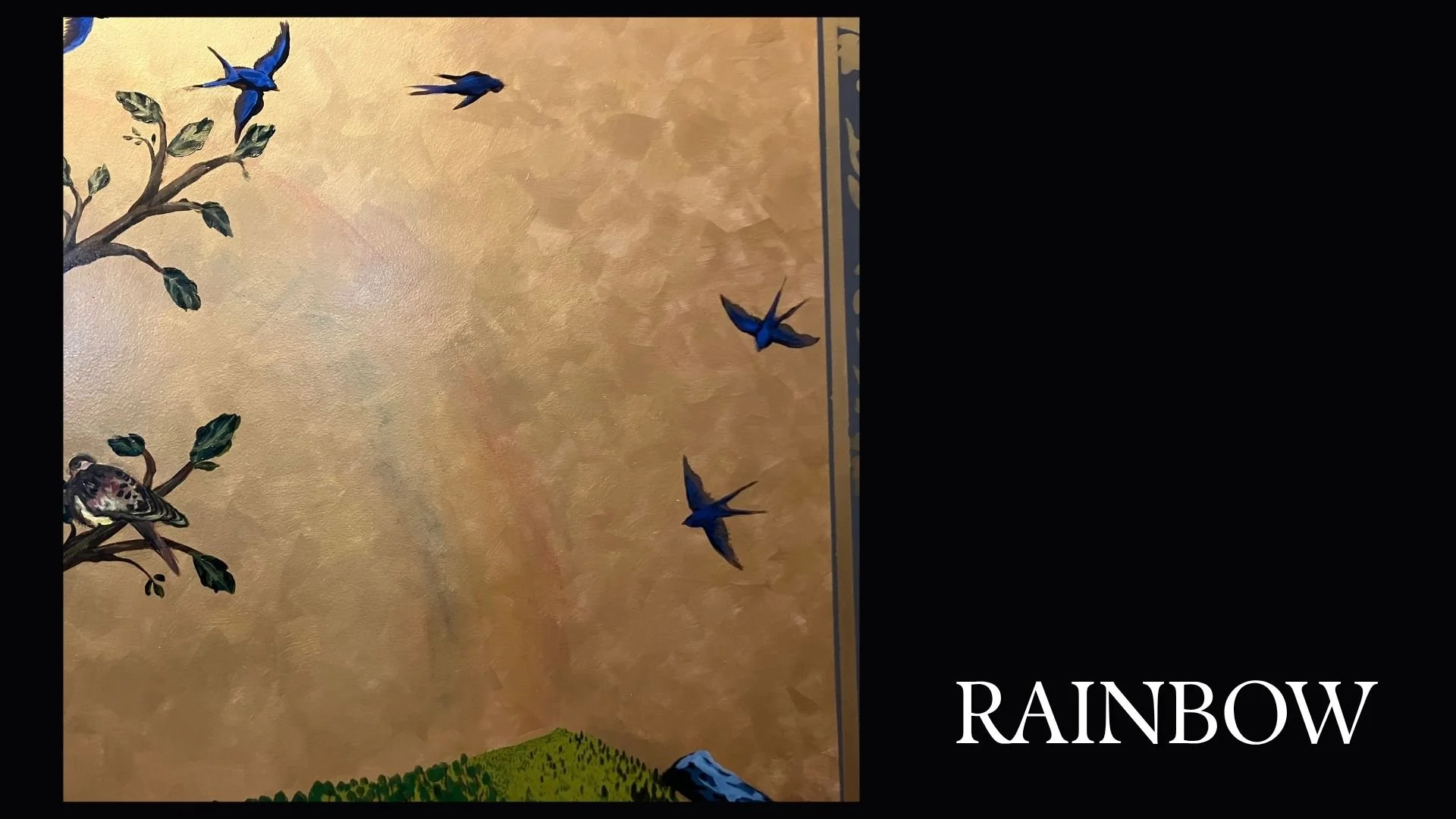
The Rainbow: A symbol of God’s covenant after the flood. “This is the sign of the covenant which I make between me and you and every living creature that is with you, for all future generations: I set my bow in the cloud, and it shall be a sign of the covenant between me and the earth. When I bring clouds over the earth and the bow is seen in the clouds, I will remember my covenant which is between me and you and every living creature of all flesh; and the waters shall never again become a flood to destroy all flesh.” (Genesis 9:12-15)
As you gaze upon our Canticle of the Creatures Mural, we hope this guide serves not merely as an explanation of artistic details, but as an invitation into a deeper encounter with God. Every brushstroke, creature, and constellation was placed with intention—offering a visual ladder to lift our hearts in gratitude and awe for the Creator’s goodness. Just as St. Francis saw the beauty of God reflected throughout all creation, may this mural inspire your own prayers of praise today and continue to unfold in meaning for generations to come.
